



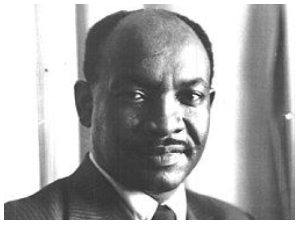
 Joseph William Swain de Graft-Johnson was Ghana’s first Vice-president of the Third Republic
Joseph William Swain de Graft-Johnson was a respected Ghanaian engineer, academic and politician who served as the first Vice-President of Ghana during the Third Republic under President Hilla Limann.
He was born on October 6, 1933, in Cape Coast in the then Gold Coast, now Ghana. De Graft-Johnson began his early education in the country and later attended Mfantsipim School, one of Ghana’s most prestigious secondary schools.
After completing his secondary education, he travelled to the United Kingdom where he studied civil engineering at the University of Leeds in West Yorkshire, earning his bachelor’s degree in the field.
Following his graduation, he worked with an engineering firm in London. During this period, he was involved in several major projects, including the construction of a power plant in Brazil and the extension of an airport in London. He later returned to Ghana where he continued to practise as a professional engineer.
De Graft-Johnson also built a strong academic career. He joined the Kwame Nkrumah University of Science and Technology (KNUST) in Kumasi as a lecturer and rose through the ranks to become a senior lecturer and later an associate professor in 1968.
His expertise in engineering and infrastructure development led to several leadership roles. In 1969, he was appointed Director of the Building and Road Research Institute.
From Resistance to Renaissance: J.W. de Graft-Johnson’s enduring impact on Ghana from August 5, 1860 – February 28, 1928
A few years later, in 1974, he became one of ten members appointed to the Ghana Highways Authority, where he also served on its board of directors.
He was also among the founding members of the Ghana Institution of Engineers (GhIE). His contribution to the profession earned him the position of President of the institution from 1977 to 1978.
Beyond Ghana, de Graft-Johnson served as a consultant to the Government of Zambia, where he advised on the establishment of the Building Research and Development Institute in Lusaka.
During the period of military rule in Ghana under the Supreme Military Council, he openly opposed the continuation of military governance. At the time, he was President of the Ghana Institution of Engineers, one of several professional bodies that publicly criticised the military regime. His stance made him the target of personal attacks.
In 1978, he was appointed a member of the Constituent Assembly tasked with drafting the 1979 Constitution, which paved the way for Ghana’s return to constitutional rule and the establishment of the Third Republic.
When the ban on political parties was lifted in 1979, de Graft-Johnson joined the People’s National Party (PNP). The party went on to win the general elections that year, and he became Vice-President under President Hilla Limann, making him the first Vice-President of the Third Republic.
However, the civilian government was short-lived. On December 31, 1981, the Limann administration was overthrown in a military coup. Following the overthrow, de Graft-Johnson went into exile in London, England.
In his personal life, he was married to Lily Anna Sekyi, and the couple had five children.
Joseph W S de Graft-Johnson died on April 22, 1999, in London at the age of 65. After a funeral service held at the Wesley Methodist Cathedral, he was laid to rest in his hometown of Cape Coast.
He is remembered for his contributions to engineering, education and Ghana’s brief but significant experiment with democratic governance during the Third Republic.
SO/VPO
Minority Leader apologises to Interior Minister over security recruitment claims



Copyright © 1994 - 2026 GhanaWeb. All rights reserved.










