


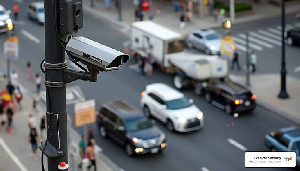
 TRAFFITECH-GH was rolled out on November 1, 2026
The National Road Safety Authority (NRSA) says it will consider giving motorists advance notice of speed cameras deployed under the Traffictech-GH system to promote fairness in road traffic enforcement.
Director-General of the Authority, Abraham Amaliba, said the NRSA would engage relevant road infrastructure agencies to install warning signs on roads where speed cameras are being used.
Five things that will determine the success of the new TRAFFITECH-GH
Speaking on Joy FM's Super Morning Show on Wednesday, November 4, 2026, during a discussion on Ghana's road safety blueprint, Amaliba acknowledged concerns that motorists could feel deliberately targeted if speed cameras were deployed without prior notice.
He explained that drivers were expected to observe displayed speed limits, particularly following public education on the Traffictech system, but agreed that additional notice would be helpful.
"Once you have the signage which says 50 km/h, as a driver, you should know that with the rollout of Traffictech, a camera will be there watching you," he said.
"But I agree that we need to give motorists notice a fair time, and we'll consider that," he added.
Amaliba said the system would rely on a combination of fixed cameras, mobile surveillance vehicles and tripod-mounted equipment to monitor speeding across the country.
He explained that mobile cameras would be moved to areas identified as hotspots for overspeeding, complementing fixed cameras installed at strategic locations.
"No, these mobile vehicles will be shifting there because there are areas that are prone to overspeeding," he said.
"So, if you don't have a camera there, this vehicle would move there to start taking the videos. The mobile cameras on the vehicles are supposed to augment the still cameras or, if you want, those fixed on the poles," he added.
He added that it would be impractical to install permanent cameras on every road in the country, making mobile surveillance necessary.
"We cannot have cameras on all our roads in the country. So these mobile cameras are still relevant. We'll still be using them," he said.
The NRSA Director-General further explained that the responsibility for installing warning signs rested with road infrastructure agencies, including the Department of Urban Roads, the Department of Feeder Roads and the Ghana Highway Authority.
"That is for the road infrastructure agencies to begin to put those things there," he said.
"We have the road infrastructure agencies like Urban Roads, Feeder Roads, Highways. So they have the responsibility to put those signs there to indicate that on this road we have a camera watching you," he added.
Amaliba also disclosed that tripod-mounted cameras would form part of the enforcement system, allowing authorities to monitor speeding from selected locations.
He stressed that none of the technologies would replace the other, as the NRSA intends to deploy all three methods to strengthen traffic monitoring and enforcement.
NA/BAI

Copyright © 1994 - 2026 GhanaWeb. All rights reserved.










