


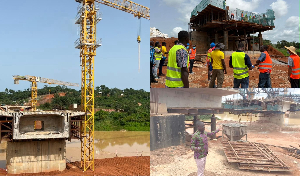
 The engineering challenges associated with the replacement were particularly significant
The replacement of the ageing bridge across the Pra River at Twifo Praso represents more than the construction of a new river crossing. It highlights a broader shift in infrastructure engineering: recognising that the long-term performance of bridges depends not only on their structural design but also on the stability, strength and behaviour of the ground supporting them.
For communities throughout the Twifo-Atti Morkwa area, the Pra River crossing serves as an important transportation link. Farmers, traders, commercial transport operators, schools and emergency services depend on reliable access across the river. Disruptions to this connection can affect agricultural distribution, commercial activity, public mobility and access to essential services.
The engineering challenges associated with the replacement were particularly significant. The surrounding river valley presented difficult ground conditions, including potentially compressible alluvial deposits, variable soil strength, groundwater fluctuations and exposure to seasonal flooding. These conditions required an approach that addressed not only the structural capacity of the bridge but also the geotechnical risks affecting its foundations, approaches and surrounding slopes.
At the centre of the project's geotechnical design approach was Ms Adwoa Tontoh, who served as the geotechnical and structural lead and Engineer of Record, according to project documentation. Her work placed particular emphasis on integrating subsurface investigation, advanced numerical modelling, foundation engineering and ground stabilisation into the overall bridge design.
## Looking beneath the surface: The engineering behind a resilient bridge
One of the most consequential aspects of the project was the attention given to subsurface conditions before finalising the foundation and approach designs.
In river environments, ground conditions can vary considerably over relatively short distances. Soft alluvial soils, saturated sand deposits, compressible silts and weathered rock can present different engineering challenges for bridge piers, abutments and approach embankments.
The investigation programme incorporated geotechnical field exploration, soil sampling, penetration testing, laboratory characterisation, groundwater assessment and river hydrological studies. These investigations were intended to establish a more reliable understanding of soil stratification, groundwater behaviour, soil strength, compressibility and potential scour exposure.
Particular attention was given to the relationship between groundwater conditions and the stability of the approach embankments. Elevated groundwater levels can increase pore-water pressures, reduce effective soil strength and contribute to slope instability. Understanding these interactions was essential to developing a foundation and earthworks design capable of accommodating seasonal changes.
The investigation findings informed subsequent analyses of foundation capacity, settlement, slope performance and ground improvement requirements.
## Advanced slope stabilisation to address flooding and ground movement
Slope stability represented another major engineering consideration.
Riverbank erosion, changing water levels and prolonged rainfall can weaken embankments and increase the potential for localised or global slope failures. For a bridge approach, such failures can compromise roadway continuity even when the bridge superstructure remains structurally sound.
The engineering approach incorporated slope stability assessments under different loading and groundwater conditions, including long-term drainage conditions, elevated wet-season groundwater levels, construction loading and rapid changes in river water levels.
Limit equilibrium methods were used to assess potential failure surfaces, while numerical modelling provided additional insight into stress distribution and the potential development of instability within the soil mass.
The resulting stabilisation recommendations included engineered slope profiles, reinforced earth systems, toe protection, drainage improvements and erosion-control measures. Rock protection and appropriate filter materials were also considered important for reducing the vulnerability of riverbank slopes to hydraulic erosion and scour.
This integrated approach is significant because it addresses a recurring weakness in bridge infrastructure: the tendency to concentrate design attention on the bridge structure while treating the surrounding embankments and riverbank slopes as secondary considerations.
## Ground reinforcement and settlement control
The performance of a bridge is also influenced by the behaviour of the roadway approaches connecting it to the surrounding transportation network.
Where embankments are constructed over compressible soils, uneven settlement can develop between the bridge structure and the approach roadway. This can create the familiar abrupt elevation difference commonly referred to as the "bump at the end of the bridge".
To address this challenge, the design approach considered geosynthetic reinforcement, mechanically stabilised earth systems and ground improvement techniques to improve load distribution and control differential settlement.
Geogrid-reinforced embankments can provide additional tensile resistance within engineered fill, improving the overall stability of approach structures. Where compressible deposits require further treatment, reinforced load-transfer platforms and ground improvement systems can help distribute embankment loads more effectively.
Preloading and prefabricated vertical drains were also considered for areas containing compressible fine-grained soils. These techniques accelerate the consolidation process, allowing a greater proportion of anticipated settlement to occur during construction rather than after the roadway is opened to traffic.
The engineering significance of these measures lies in their ability to improve the transition between the bridge and the approach roadway, reducing the potential for uneven settlement, pavement distress and recurring maintenance interventions.
## Accounting for seismic risk and liquefaction potential
Although Ghana is generally characterised by relatively low to moderate seismic activity, geotechnical engineers cannot disregard the potential effects of seismic loading, particularly where saturated granular deposits are present.
Loose, water-saturated sands can lose substantial strength during earthquake-induced ground shaking, potentially resulting in liquefaction, settlement and lateral ground movement.
The project's geotechnical assessment considered the susceptibility of saturated soil deposits to liquefaction using penetration-test-based evaluation procedures. The assessment framework also considered potential post-liquefaction settlement and the implications of lateral ground movement for bridge foundations and abutments.
Ground improvement techniques, including stone columns, soil stabilisation and densification methods, were evaluated as potential measures for addressing vulnerable soil conditions.
Such engineering considerations are important because foundation systems must maintain adequate performance not only under ordinary service conditions but also under less frequent and more demanding environmental loading scenarios.
## Drainage: An essential component of foundation and slope protection
Another important aspect of the engineering approach was the integration of drainage into the geotechnical design.
Water accumulation behind bridge abutments and retaining structures can generate hydrostatic pressure, increase lateral loading and contribute to the deterioration of supporting soils. Similarly, uncontrolled surface runoff can erode embankments and accelerate slope instability.
The proposed drainage measures included subsurface collector systems, drainage layers, appropriately designed filters, surface-water conveyance and provisions for safely discharging collected water away from critical foundation areas.
Horizontal drains and drainage blankets were also considered for managing groundwater pressures within susceptible slope zones.
These measures demonstrate an important engineering principle: drainage is not simply a supporting construction feature. It is a fundamental component of geotechnical stability, foundation performance and infrastructure durability.
## Integrating soil and structural engineering
Perhaps the most important technical dimension of the project was the emphasis on evaluating the bridge and its supporting ground as an interconnected engineering system.
Traditional structural analysis can simplify foundations as fixed supports. However, actual foundation behaviour is influenced by soil stiffness, groundwater conditions, loading history, lateral resistance and changes in the surrounding ground.
The design approach incorporated soil-structure interaction considerations to evaluate how foundation elements would respond to vertical and horizontal loads.
For deep foundation systems, this included consideration of axial load transfer, lateral pile response, group effects and the influence of riverbed scour on available foundation resistance.
The analyses also considered potential negative skin friction associated with consolidating soils, lateral ground movement and the interaction between bridge abutments and approach embankments.
Through these assessments, the engineering team sought to establish that the foundation system could maintain adequate structural capacity while controlling settlement, rotation and lateral displacement.
This integration of geotechnical and structural analysis is increasingly important for infrastructure exposed to changing groundwater conditions, flood events and complex subsurface environments.
## Why the project matters beyond Twifo Praso
The significance of the New Twifo Praso Bridge Replacement Project extends beyond its immediate geographical location.
Across Ghana and other developing economies, bridges frequently serve as essential links between agricultural production areas, commercial centres, industrial facilities and public services. Their failure or prolonged closure can disrupt transportation networks, increase travel distances and impose significant economic costs on surrounding communities.
The engineering challenges encountered at Twifo Praso are also relevant to infrastructure development elsewhere. These include variable soil conditions, river scour, embankment instability, groundwater fluctuations and the need to accommodate increasingly demanding environmental conditions.
By incorporating geotechnical investigation, numerical modelling, foundation engineering, slope stabilisation and drainage into a coordinated design philosophy, the project illustrates how infrastructure resilience must be addressed from the ground up.
The approach also highlights the importance of considering the entire bridge corridor rather than evaluating the superstructure in isolation.
## The engineer behind the geotechnical approach
Ms Adwoa Tontoh's contribution reflects the increasingly important role of specialised geotechnical engineering in the delivery of critical infrastructure.
Her involvement in the project's geotechnical and structural design brought together several interconnected engineering disciplines, including subsurface characterisation, foundation evaluation, slope stability, soil reinforcement and soil-structure interaction.
Rather than treating these disciplines as separate design exercises, the approach considered how decisions in one area influence performance in another. Foundation depth, for example, must account for soil strength and scour exposure, while embankment design must consider consolidation, groundwater conditions and the potential for differential settlement.
This systems-based approach is particularly relevant to bridges located in river valleys, where the combined effects of water movement, changing soil conditions and structural loading can determine the long-term reliability of the crossing.
## A broader lesson for infrastructure development
The New Twifo Praso Bridge Replacement Project provides an important opportunity to examine how engineering decisions made beneath the ground can influence the performance of infrastructure above it.
As governments invest in transportation corridors, bridges, dams and other critical public assets, the need for technically sound geotechnical design continues to grow. Infrastructure resilience requires more than stronger concrete and steel. It requires a detailed understanding of the ground, appropriate foundation systems, effective drainage and the ability to anticipate how environmental conditions may affect performance over time.
For Twifo Praso, the broader engineering lesson is clear: the long-term reliability of a bridge begins long before the first structural element is erected. It begins with understanding the ground, evaluating its limitations and designing systems capable of working with those conditions.
The project underscores the value of integrating advanced geotechnical engineering into infrastructure development and demonstrates why the expertise of engineers working at the intersection of soil mechanics, foundation design and structural performance is increasingly important to the future of resilient transportation networks.

Copyright © 1994 - 2026 GhanaWeb. All rights reserved.










