



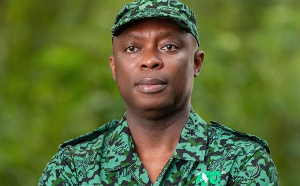
 Dr Hugh Brown, CEO of the Forestry Commission
Ghana’s forest protection system is under severe strain as illegal mining (galamsey) and illegal logging continue to outpace enforcement efforts across major forest reserves, the Forestry Commission has warned.
Speaking at the handing over and inauguration of 10 forest protection camps and two checkpoint accommodation facilities under the UK-Ghana Forest Governance Partnership at the Oda River Forest Reserve in the Ashanti Region, the Chief Executive of the Forestry Commission, Dr Hugh Brown, said the country is undergoing a “major shift from reactive forest management to continuous on-site protection and rapid response operations.”
He, however, cautioned that behind the new infrastructure push lies a difficult operational reality, with forest guards heavily outnumbered and under-resourced in the face of increasingly sophisticated environmental crimes.
Ghana, UK commission 12 new forest protection facilities to tackle galamsey
Dr Brown disclosed that the Commission is currently facing a significant manpower gap, noting that “as at the beginning of this year the Resource Guard shortfall was reported to be in excess of 2,500.”
He further warned that illegal operators are now deploying advanced tools and coordinated networks, making enforcement more dangerous and complex.
“They use sophisticated equipment, heavy-duty machines, chainsaws, motorbikes, advanced communication systems, and highly organised networks,” he said, adding that “in some instances, our officers encounter armed resistance and coordinated criminal operations deep within the forest reserves.”
Ghana’s forest reserves, particularly in the Ashanti, Western, Western North, Ahafo, and Bono regions, continue to suffer extensive degradation.
According to Dr Brown, “thousands of hectares of forest reserves have been degraded,” with severe impacts on rivers, biodiversity, wildlife habitats, and national water security.
He noted that the traditional patrol system, which relied on forest guards travelling long distances from nearby communities, is no longer adequate.
“While that system may have worked in the past, the nature of illegal activities today has changed significantly,” he said.
The newly commissioned forest protection camps are expected to strengthen enforcement by providing permanent on-site presence in key hotspots.
Dr Brown said the camps would ensure officers are no longer isolated in their duties, stressing that “there is strength and synergy in numbers.”
He added that the facilities will improve rapid response to illegal activities and enhance surveillance and intelligence gathering, serving as a strong deterrent to offenders.
Despite these gains, Dr Brown cautioned that infrastructure alone is not sufficient.
He called for urgent investment in recruitment, logistics, and welfare, noting that many officers remain “overstretched, with limited numbers covering vast forest landscapes under very difficult conditions.”
He stressed the need for a multi-stakeholder approach involving security agencies, traditional authorities, the judiciary, and local communities to effectively combat forest destruction.
“If we fail to act collectively and decisively, the consequences will impact not only our forests but also agriculture, water supply, climate resilience, public health, and national development,” he warned.
Meanwhile, the UK Government, in collaboration with Ghana, has commissioned the facilities as part of efforts to strengthen forest governance and enforcement capacity.
Speaking at the ceremony, the Acting Deputy UK High Commissioner, Dr Terri Sarch described the initiative as a practical demonstration of bilateral cooperation in protecting Ghana’s natural resources.
She said the facilities will enhance frontline presence, improve monitoring and rapid response, and support officers stationed in forest reserves.
“These facilities are a practical expression of partnership. They will help strengthen field presence, support rapid response, and provide the infrastructure needed by those safeguarding Ghana’s forests every day,” she said.
She added that illegal mining, logging, and encroachment continue to threaten Ghana’s forests, reaffirming the UK’s commitment to long-term support for sustainable forest management.

Copyright © 1994 - 2026 GhanaWeb. All rights reserved.










