


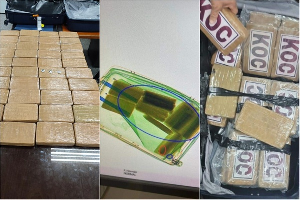
 Photos of the suspected drugs allegedly seized in Beirut from Accra
The arrest of a Syrian national at Lebanon's Rafic Hariri International Airport with 46.7 kilogrammes of cocaine reportedly transported from Accra has raised questions about Ghana's role in the shipment and the effectiveness of the country's drug enforcement system.
While Ghana's Narcotics Control Commission (NACOC) has described the arrest as the outcome of a coordinated controlled delivery operation involving Ghanaian and Lebanese authorities, aspects of its account have been questioned by security experts, particularly in relation to the circumstances surrounding the seizure.
The Lebanese authorities, in their initial account, credited their Customs and General Security agencies with foiling the smuggling attempt but made no explicit mention of Ghanaian authorities or NACOC's alleged involvement in a joint operation. There is also a discrepancy in the quantity of cocaine reported, with Lebanese Customs stating that 46.7 kilogrammes were seized, while NACOC put the amount at approximately 40 kilogrammes.
These differences have prompted questions from security analysts, including Vice President of IMANI Africa, Bright Simons, and security expert Adib Saani of the Jatikay Centre, about whether the operation was indeed a controlled delivery, when Ghanaian authorities became aware of the shipment and why the suspect was allowed to depart Accra with the drugs.
Here is what we know so far about the cocaine seizure and the questions surrounding it.
'How many more cocaine seizures before this government accepts' - Osei-Asare asks
1. How the cocaine was intercepted
Lebanon's General Directorate of Customs announced on Sunday, November 1, 2026, that it had foiled a major drug-smuggling operation at Rafic Hariri International Airport in Beirut in collaboration with the country's General Security.
According to the Lebanese authorities, the operation took place on Saturday, October 31, 2026, and resulted in the seizure of 46.7 kilogrammes of cocaine, described as the largest drug bust in the history of the airport.
The drugs were found in the luggage of a Syrian passenger identified only by his initials, B.H., who had arrived in Lebanon from Accra, Ghana, aboard Middle East Airlines flight MEA 576.
A search of his luggage uncovered 40 packages of cocaine concealed using sophisticated methods, including complex packaging and insulation materials designed to evade detection by scanning equipment. Electronic tracking devices were also discovered inside the packages.
2. What Lebanese authorities said about the suspect
Preliminary investigations by Lebanese Customs indicated that the suspect had entered Lebanon through the Masnaa border crossing several weeks before the arrest.
He subsequently travelled to Accra and returned to Beirut with the consignment, leading investigators to suspect that he had been tasked with transporting and delivering the drugs as part of an organised smuggling operation.
The suspect was arrested, while Lebanese Customs said investigations were continuing to identify the individual who was expected to receive the shipment at a designated location.
3. NACOC's account of the operation
Following reports of the seizure, Ghana's Narcotics Control Commission issued a statement confirming the arrest of the Syrian national on Saturday, October 31, 2026, at Rafic Hariri International Airport.
NACOC said the suspect arrived from Accra with approximately 40 kilogrammes of suspected cocaine concealed in two pieces of luggage.
The commission described the arrest as the outcome of a coordinated controlled delivery exercise involving Ghanaian and Lebanese drug law enforcement authorities.
It explained that the operation was intended to identify and apprehend individuals at both ends of the drug supply chain while gathering intelligence to dismantle the wider transnational criminal network behind the shipment.
NACOC further disclosed that it was working to arrest the suspect's accomplices in Ghana.
4. Lebanese Prime Minister praises security agencies
Following the seizure, Lebanese Prime Minister Nawaf Salam congratulated the country's General Security and Customs agencies for foiling the smuggling attempt.
In a statement released by the Grand Serail on X, Salam praised the coordination, cooperation and information-sharing between the two Lebanese agencies, which he said had led to the successful operation.
He stressed that Lebanon's land, sea and air border crossings would not serve as conduits for drug smuggling, money laundering or other illegal activities.
The Prime Minister also reaffirmed the government's commitment to strengthening border controls, improving coordination among relevant agencies and combating organised crime.
Bright Simons questions NACOC's account
Vice President of IMANI Africa, Bright Simons, has raised what he describes as worrying gaps in NACOC's explanation of the operation.
In an analysis of the seizure, Simons questioned the commission's claim that the arrest resulted from a controlled delivery exercise conducted jointly with Lebanese authorities.
He pointed out that the Lebanese authorities' statements credited their Customs and General Security agencies with the operation without explicitly acknowledging Ghana's involvement.
He also noted that Lebanon's anti-narcotics unit operates under the Internal Security Forces (ISF) and argued that its absence from the official account was significant, particularly because the unit is usually mentioned in statements concerning joint anti-narcotics operations.
Simons further cited Lebanese reports that the suspect was suspected of paying a bribe at Accra International Airport to facilitate the passage of his two suitcases.
He questioned how such a payment could have occurred if Ghanaian authorities had already identified the shipment and were supervising its movement as part of a controlled delivery operation.
He also raised questions about why NACOC had not announced the arrest of suspected accomplices in Ghana, including officials who may have facilitated the movement of the shipment.
According to him, Lebanese investigators appeared to have been monitoring the suspect before his arrival in Ghana, following his earlier entry into Lebanon through the Masnaa border crossing.
Simons argued that this raised the possibility that Lebanese authorities had contacted their Ghanaian counterparts only after the suspect had been arrested.
He called for a joint statement from Lebanon's Internal Security Forces and NACOC to clarify the circumstances surrounding the operation.
Jatikay Centre demands answers
Security expert Adib Saani, writing on behalf of the Jatikay Centre, also questioned NACOC's explanation, describing it as unsatisfactory and potentially an attempt at damage control.
The centre said the seizure was a major embarrassment to Ghana and raised serious questions about the country's narcotics enforcement system and broader national security architecture.
It questioned why the suspect was allowed to leave Accra International Airport with such a substantial quantity of cocaine if Ghanaian authorities already knew about the shipment.
The centre also demanded clarification on when the drugs were detected
BAI

Copyright © 1994 - 2026 GhanaWeb. All rights reserved.










