



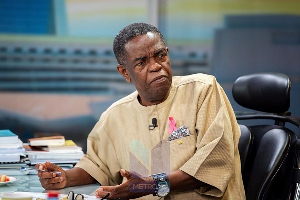
 Kwesi Pratt Jnr is the Managing Editor of the Insight Newspaper
GhanaWeb Feature by Veronica Penelope Onuman
In 2018, the debates on the Ghana-US security deal sparked fierce debates within political circles, particularly between security experts and some notable Ghanaians.
Notable among the opposers of the deal was veteran journalist Kwesi Pratt Jr, who contended that the Ghana-US Security pact, which was eventually passed, places the country in a position that makes it the enemy of the Western country’s enemy.
Security expert Professor Kwesi Aning corroborated same, stressing that the agreement opens the country to threats of terrorism.
When Kwesi Pratt Jr strongly opposed Ghana’s decision to enter into a defence cooperation agreement with the United States, his warning was clear: allowing a foreign military presence could compromise Ghana’s sovereignty and expose the country to unnecessary external threats.
At the time, his stance sparked intense national debates, with critics dismissing his concerns as alarmist, while supporters praised his caution.
Today, amid escalating tensions involving Iran, Israel, and the United States, Pratt’s arguments are being revisited with renewed urgency.
Akufo-Addo approves agreement for US military base in Ghana
Background
The agreement, which is titled 'Agreement Between the Government of the United States of America and the Government of the Republic of Ghana on Defence Cooperation, the Status of United States Forces and Access to and Use of Agreed Facilities and Areas in the Republic of Ghana,’ was signed under the government of former President Nana Addo Dankwa Akufo-Addo.
The agreement, uncovered by GhanaWeb, came with a $20 million grant to Ghana and was signed in Accra on May 9, 2018, by the then Minister of Defence, Dominic Nitiwul, despite stiff opposition from a faction of the public, who argued that it was not in the interest of Ghana and would make the country a target for enemies of the United States.
It clarified "access to and use of agreed facilities and areas by United States forces, thereby facilitating training, including to maintain unit readiness, combined exercises, and other military engagement opportunities."
It also stated that "United States forces may undertake the following types of activities in Ghana: training; transit; support and related activities; refuelling of aircraft; landing and recovery of aircraft; accommodation of personnel; communications; staging and deploying of forces and materiel; exercises; humanitarian and disaster relief; and other activities as mutually agreed."
The defence agreement also listed the agreed facilities and areas in Ghana that the US army had unfettered access to, including an "exercise/operations support area located at a Ghana military facility adjacent to the Kotoka International Airport" and a "Primary Parking Area located at the Ghana military facility adjacent to the Kotoka International Airport."
FULL TEXT: The controversial military agreement Ghana signed with the US
A Changing Global Security Landscape
Recent developments in the Middle East have demonstrated how quickly geopolitical alliances can translate into real security risks. Countries such as the United Arab Emirates, Qatar, and Kuwait (all close allies of the United States) have found themselves exposed to threats and, in some cases, attacks linked to regional conflicts involving Iran.
These incidents paint a broader picture of the reality of modern geopolitics, in the sense that states that host or align closely with major military powers can become entangled in conflicts far beyond their borders.
It is precisely this scenario that Kwesi Pratt Jr warned against.
The Case Against Foreign Military Presence
Pratt’s opposition was rooted in a long-standing principle: non-alignment. For decades, countries like Ghana have sought to maintain balanced foreign relations, avoiding deep entanglements in global power rivalries.
His concerns can be summarised in three key points:
Loss of neutrality: Hosting a US military base could signal alignment with American strategic interests;
Security risks: Ghana could become a symbolic or strategic target in global conflicts;
Sovereignty concerns: Foreign military presence may limit national control over security decisions.
In light of recent attacks on US-aligned countries, these fears appear less theoretical than before.
A Different Context for Ghana
However, Ghana’s situation differs significantly from that of Middle Eastern states. Unlike the UAE or Qatar, Ghana is not directly involved in the geopolitical struggles between Iran, Israel, and the United States. It does not host major combat operations, nor is it geographically situated in a high-conflict zone.
This distinction is crucial.
While US allies in the Middle East are deeply embedded in regional security dynamics, Ghana’s engagement with the United States has largely been viewed as cooperation rather than strategic militarisation.
The Argument for Cooperation
Supporters of the agreement argue that it brings tangible benefits to Ghana, including:
1.Enhanced military training and capacity;
2.Intelligence sharing, particularly in response to growing insecurity in West Africa;
3.Access to logistical and technological support;
4.Strengthened diplomatic relations with a global power.
In a region facing rising threats from extremist groups, such cooperation is seen as a practical necessity rather than a geopolitical gamble.
Weighing the Risks and Realities
So, was Pratt right?
In principle, his concerns are grounded in a realistic understanding of international relations. History shows that military alliances can carry unintended consequences, including exposure to external threats. The experiences of US allies in volatile regions reinforce this point.
Yet, in practice, Ghana’s risk profile remains relatively low. Its geographic distance from major conflict zones and its limited military role in global operations reduce the likelihood of direct retaliation.
Conclusion
Kwesi Pratt Jr’s opposition to Ghana’s defence agreement with the United States reflects a broader debate about sovereignty, security, and global alignment. While recent global tensions lend weight to his warnings, Ghana’s unique position suggests that the immediate risks may not be as severe as feared.
Ultimately, the question is not whether Pratt was entirely right or wrong, but whether Ghana can strike the right balance, leveraging international partnerships for security while preserving its independence and minimising exposures to global conflicts.

Copyright © 1994 - 2026 GhanaWeb. All rights reserved.










