


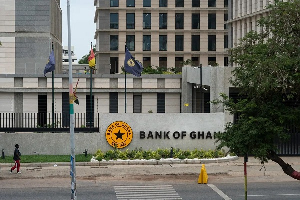
 The Bank of Ghana (BoG) headquarters
Small and medium-sized enterprises (SMEs) in Ghana continue to face borrowing costs exceeding 30 percent on some bank facilities, despite significant declines in benchmark interest rates, highlighting persistent structural constraints in the country’s credit market.
The gap between policy rates and the actual cost of borrowing reflects factors including credit risk premiums, banks’ funding expenses, operating costs, capital requirements and the limited financial records available for assessing many smaller businesses.
Average commercial bank lending rates declined from 20.58 percent at the beginning of 2026 to 15.94 percent by mid-October, while the Ghana Reference Rate (GRR), which serves as a base rate for bank lending, fell from 15.68 percent to 10.04 percent.
The Monetary Policy Rate (MPR), meanwhile, declined from 15.50 percent to 14 percent during the year, following substantial monetary easing in the second half of 2025.
The figures indicate that average lending rates have adjusted faster than the MPR this year. However, the difference between the average lending rate and the GRR widened from 4.90 percentage points in January to 5.90 percentage points when the October reference rate is compared with the latest published average lending rate.
The divergence highlights why reductions in benchmark rates do not automatically translate into equivalent savings for individual borrowers.
Businesses with dependable cash flows, audited accounts, strong repayment histories and valuable collateral are generally better positioned to negotiate favourable lending terms. Smaller enterprises with irregular sales, limited security and weak financial documentation may face substantially higher rates or struggle to access formal bank credit.
The Bank of Ghana (BoG) has attributed the incomplete transmission of monetary policy to structural and market-specific constraints, including weak borrower information, high perceived default risks, and collateral enforcement challenges and slow deposit repricing.
In response, the central bank has proposed a Credit Risk Management Directive intended to improve credit assessment, monitoring and early identification of problem loans. The draft, open for public and industry comments until November 30, seeks to establish consistent standards for regulated financial institutions.
The BoG is also targeting a reduction in commercial banks’ non-performing loan ratios to 10 per cent or below by the end of 2026, as part of efforts to strengthen balance sheets and improve credit discipline.
Meanwhile, businesses are seeking to improve their credit profiles through more transparent financial records, credit-reference systems and risk-sharing arrangements. Industry groups are also engaging lenders over additional charges, including processing and arrangement fees, which increase the effective cost of borrowing.
Banks are under pressure to balance lending to productive sectors with the need to maintain asset quality and adequate returns.
The central bank expects stronger credit information systems, improved collateral enforcement and sustained macroeconomic stability to improve the transmission of policy-rate changes to borrowing costs.
Until these constraints ease, however, lower benchmark rates alone may not guarantee affordable financing for smaller businesses, which remain among the borrowers most exposed to high credit costs.

Copyright © 1994 - 2026 GhanaWeb. All rights reserved.










