


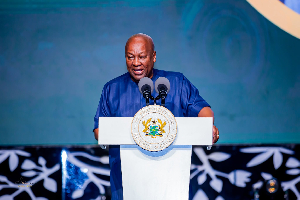
 John Dramani Mahama is the President of the Republic of Ghana
The Institute of Economic Affairs (IEA) has outlined seven key reasons Ghana should pursue a partnership with the BRICS bloc, citing opportunities for increased trade, investment, industrialisation and economic independence.
The Institute says Ghana’s proposed move to secure BRICS partner-country status could help the country diversify its international partnerships, attract new sources of financing and strengthen its position in the changing global economy.
Ghana must understand benefits of BRICS partnership before proceeding – Expert
In a press statement dated Monday, November 9, 2026, the IEA endorsed the government's decision to pursue the partnership following Cabinet approval, arguing that Ghana has the sovereign right to choose its international partners without seeking approval from external powers.
Below are seven reasons the IEA believes a BRICS partnership could benefit Ghana.
1. Access to bigger international markets
The IEA says BRICS offers Ghana an opportunity to expand its trade and reach new markets beyond its traditional trading partners.
With a combined population of more than 3.5 billion people and about 30 per cent of global economic output, the bloc could provide Ghanaian businesses with opportunities to increase exports and build new commercial relationships.
2. More investment in local industries
The Institute believes stronger ties with BRICS economies could attract investment into key sectors, including manufacturing, agro-processing, energy, transport infrastructure, and mineral processing.
It says such investments could help Ghana move away from depending heavily on exporting raw or minimally processed commodities.
3. Technology transfer and industrial development
According to the IEA, partnership with BRICS countries could create opportunities for joint ventures, technology transfer and industrial cooperation.
This, it argues, could strengthen local production capacity, develop domestic expertise and enable Ghana to retain more value from its natural resources.
4. More options for development financing
The IEA says engagement with BRICS countries and institutions such as the New Development Bank could give Ghana additional financing options for infrastructure and other development projects.
It stressed that the objective should not be to replace existing sources of funding but to broaden the country's options and improve its bargaining position.
5. Reduced pressure on foreign exchange reserves
The Institute believes greater use of local currencies in trade with BRICS countries could reduce Ghana's dependence on third-party currencies and lower foreign exchange conversion costs.
It says this could ease pressure on the country's foreign exchange reserves and reduce exposure to exchange rate fluctuations.
6. Ghana can strengthen its economic and diplomatic independence The IEA argues that Ghana should be free to pursue relationships that advance its national interests without allowing the geopolitical rivalries of other countries to dictate its foreign policy.
“Ghana’s decision to join BRICS as a partner-country must therefore be understood for what it is: an exercise of sovereign choice, not an act requiring the permission, endorsement or validation of external powers,” the statement said.
7. Partnership will complement existing international relationships
The Institute maintains that joining BRICS does not mean Ghana must abandon its relationships with the United States, United Kingdom, European Union, International Monetary Fund (IMF) and World Bank.
Rather, it believes working with different economic partners could create more opportunities in trade, finance, education, technology, infrastructure and security while reducing excessive dependence on any single partner.
The IEA has urged the government to establish the necessary policies and institutional arrangements to ensure Ghana maximises the benefits of the proposed partnership.
It added that the ultimate measure of the partnership should be its ability to create jobs, strengthen the economy and improve the welfare of Ghanaians.
NA/EA
Inside Ghana's Human Trafficking Network: How the Operations Work

Copyright © 1994 - 2026 GhanaWeb. All rights reserved.










