



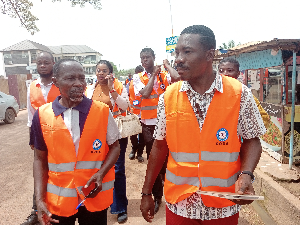
 Shai Osudoku DCE (r) with the Rating Officer (l) and other field officers
The District Chief Executive (DCE) for the Shai Osudoku District Assembly, Ignatius Godfred Dodoe, has announced the commencement of a comprehensive revenue mobilisation exercise aimed at establishing the district’s first scientific and centralised revenue database.
Addressing the media at a brief ceremony, Dodoe explained that the exercise marks a significant reform in the Assembly’s revenue administration system, describing it as a historic step towards transparency, efficiency, and improved fiscal performance.
According to him, prior to his assumption of office, the Assembly operated without a reliable revenue database, relying instead on fragmented and disjointed data that made it difficult to determine the true revenue potential of the district.
“When I assumed office, there was no comprehensive database. What existed were bits and pieces of information, which made it impossible to accurately assess our revenue base and potential,” he stated.
Establishment of a Scientific Revenue Database
To address the challenge, the Assembly has engaged an experienced Rating Officer with over a decade of professional practice to guide the development of a modern revenue database.
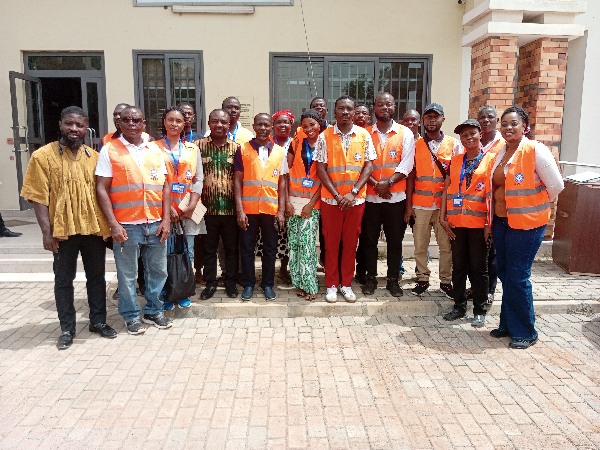
The exercise will involve the enumeration and registration of all businesses, companies, buildings, kiosks, containers, and other rateable properties across the district. Each property and business entity will be captured into a centralised digital system that will automatically calculate rateable values and generate bills.
The Assembly Chief disclosed that 44 trained field officers have been commissioned for the month-long exercise. Each officer has been equipped with a tablet installed with specialised software to capture data, including GPS coordinates, ownership details, business classifications, and applicable rateable values.
All data collected in the field will be transmitted to a central server at the Assembly’s office for real-time monitoring and verification.
“While officers are in the field, we will monitor their work from the office. Where corrections are required, we will address them immediately. The system is transparent and reliable,” the DCE noted.
Phased Zonal Approach
The district has been divided into zones, with personnel grouped into three operational teams. As each zone is completed, bills will be generated and served immediately rather than waiting for the entire district-wide exercise to conclude.
The Assembly intends to complete the exercise by May or June, 2026, depending on prevailing challenges, including weather conditions and logistical constraints such as limited vehicles.
Despite these challenges, Dodoe expressed confidence that the initiative would increase the Assembly’s internally generated funds by at least 40 per cent, with a revenue target of between GH¢8 million and GH¢9 million for the year.
Tackling Revenue Leakages and Fraud
The DCE also revealed that the Assembly has uncovered instances of fraud and revenue leakages involving unscrupulous individuals issuing fake bills and forging official documents, including his signature.
In response, the Assembly has resolved to print its own bills internally to eliminate dependence on external printing arrangements, which he described as prone to corruption.
Security agencies have been engaged to support the exercise, and officers can be identified by their reflective jackets, official logos, identification cards, and authorisation letters.
Individuals who refuse to comply will first be invited for engagement, after which legal measures may be applied if necessary.
Public Education and Compliance
As part of the rollout, the Assembly has launched a public education campaign through information centres, social media platforms, jingles, and mobile information vans to sensitise residents and business operators.
The DCE acknowledged that some businesses have operated for years without receiving rate bills, while others have accumulated arrears. He assured that outstanding arrears would be factored into the new system and structured appropriately to ensure fairness.
“Our system is open. If a ratepayer has concerns, they can come to the office for resolution. We are not adversarial; we are cooperative. We want a win-win situation for the district,” he said.
Multi-Layered Operational Structure
Providing further details, the Assembly’s Rating Officer, Sylvester Axame, explained that the field operation is structured in three layers: numbering of properties, data collection on businesses and properties, and recovery of outstanding revenues from previous years.
He indicated that the teams are conducting a “mass attack” strategy, focusing on completing one community or town council area before moving to the next, due to limited vehicles and the ongoing rainy season.
“If weather conditions permit, we expect to complete the exercise by May,” Axame added.
Performance-Based Retention
The DCE further disclosed that field officers who demonstrate exceptional performance during the exercise may be retained as permanent revenue collectors, as part of efforts to strengthen the Assembly’s revenue mobilisation capacity.
Dodoe called on the media to support the initiative through sustained public education, emphasising that improved revenue mobilisation is essential for financing local development projects and strengthening service delivery in the district.
He expressed optimism that the exercise would lay a solid foundation for a more accountable and financially sustainable Shai Osudoku.

Copyright © 1994 - 2026 GhanaWeb. All rights reserved.










