



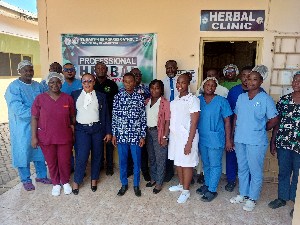
 A cross section of some participants during the commissioning
The St. Martin’s de Porres Hospital in Agormanya in the Eastern Region is strengthening healthcare integration and innovation by responding to patient preferences and national health policy through the formal introduction of scientifically regulated herbal medicine into its service delivery system.
The facility on Monday, January 05, 2026 commissioned a fully equipped herbal clinic, marking a significant expansion of its healthcare services and reinforcing Ghana’s commitment to integrated medical practice.
The new facility positions the hospital as a pioneer among Catholic Health Association of Ghana (CHAG) institutions in the formal provision of herbal medicine within an orthodox healthcare setting.
The herbal clinic, which has been added to the hospital’s existing services, is furnished with a modern laboratory and stocked with certified herbal medical products sourced from well-resourced suppliers, including the Centre for Scientific Research into Plant Medicine (CSRPM).
Hospital authorities say the development is a direct response to patient demand and evolving healthcare needs.
Speaking at the commissioning, the Deputy Administrator of the hospital, Grace Nettey, explained that management was motivated by consistent feedback from patients who expressed a preference for herbal treatment alongside orthodox medicine.
“Per the cases received and the feedback from our clients, we realized that some of our clients prefer herbal treatment to orthodox medication,” she said. “This prompted management to work around the clock to establish a well-furnished herbal clinic for clients who would opt for herbal treatment.”
Ms. Nettey noted that although Ghana trains medical herbalists through institutions such as the Kwame Nkrumah University of Science and Technology (KNUST), qualified professionals remain limited within the healthcare system, making staffing a key challenge.
“KNUST trains herbal doctors, but they are not many in the system, and getting them to manage the facility is not easy,” she stated. “We have worked diligently on documentation and regulatory processes because St. Martin’s is a one-stop shop. When patients come here, all their healthcare needs should be met.”
According to her, access to the herbal clinic will be based on referrals and patient preference, with services open to clients from different jurisdictions. She assured the public of quality service delivery, affordability, and professionalism, expressing confidence that patronage would be high.
The Head of the Herbal Medicine Unit, Atsa-Nunyawu Talent-Atsu, a Medical Herbalist, underscored the broader significance of the initiative within Ghana’s health system.
Addressing participants during the commissioning ceremony, he referenced the World Health Organization’s position on universal health coverage.
“The World Health Organization has observed that universal health coverage would not be possible without integrating or involving traditional medicine,” he said. “Ghana happens to be the first country in Africa to have integrated herbal medicine into its official healthcare system, and St. Martin’s Hospital is the first among CHAG institutions to introduce it.”
Atsu described the development as a clear demonstration of the hospital management’s commitment to inclusive and patient-centred healthcare. He encouraged public engagement with the facility and sought to dispel misconceptions surrounding herbal medicine.
“Most people fear that herbal medicine will destroy them, but this is not the case,” he said. “The facility is ready to provide all necessary information about herbal medicine to the public.”
In a subsequent interview, Atsu explained the scientific basis for integrating herbal medicine into mainstream healthcare. He noted that herbal medicines contain phytochemicals to which microorganisms do not easily develop resistance, making them particularly useful in managing certain medical conditions.
“When we incorporate herbal medicine into the main health system, it helps us handle a number of conditions, especially chronic ones, that orthodox medicine may not fully address,” he explained. “Orthodox medicine is very effective in emergency situations requiring quick intervention, while herbal medicine plays a complementary role.”
He emphasized that herbal medicine is widely relied upon by the public, is generally affordable, and can be safe and effective when used within a scientifically regulated framework.
The commissioning of the herbal clinic at St. Martin’s de Porres Hospital represents a strategic step toward holistic healthcare delivery, aligning patient choice, scientific validation, and national health policy in a single institutional framework.

Copyright © 1994 - 2026 GhanaWeb. All rights reserved.










