



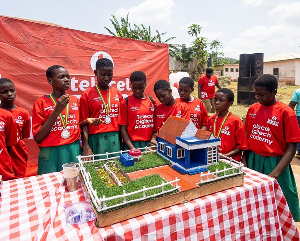
 Telecel DigiTech Academy showcase their capstone projects at the ceremonies
A total of 500 upper primary and junior high students from five regions have graduated as part of the third cohort of the Telecel Foundation’s DigiTech Academy, a 12-week after-school digital skills training programme focused on robotics, coding, web design and Internet of Things (IoT) applications.
At the headline graduation ceremony in Peki Blengo in the Volta Region, students from Peki Blengo Evangelical Presby JHS and Peki Adzokoe Roman Catholic School showcased their team-built capstone projects and locally relevant solutions, including an automated irrigation system, smart night light, distance monitoring system and security alarm system.
After three months of practical learning and innovation, Telecel DigiTech Academy, in partnership with the Ghana Education Service, the National STEM Centre and with implementing support from Mingo Foundation and Asustem Robotics, held simultaneous ceremonies held across five regions to celebrate and reward the ingenuity of the young learners.
In the third cohort, 500 students from 19 schools in five districts: South Dayi in the Volta Region, Mfantsiman in the Central Region, Jirapa in the Upper West Region, Goaso in the Ahafo Region and Bolgatanga in the Upper East Region completed the programme, receiving training in Scratch programming, Arduino-based robotics and website design.
Headteacher of Peki Blengo EP JHS, Vincent Adzagbenu, said the initiative had significantly expanded students’ confidence and creativity. “Our students are now thinking differently. They are applying what they learn to solve real problems around them, and that is the kind of education that truly prepares them for the future.”
The Director of External Affairs at Telecel Ghana, Komla Buami, said DigiTech Academy continues to prove that young people in local communities can thrive when given practical digital opportunities.
“These projects on display show that talent exists everywhere and what matters is creating access and giving students room to experiment, build and discover their own abilities,” Mr Buami said. “Telecel Foundation is also ensuring the sustainability of these skills by training local teachers to pass on the knowledge to more students who will lead the future of the digital revolution.” Deputy Director of Finance and Administration at the South Dayi Education Directorate, Rev. Gideon Korsi Asiam, at the ceremony described the initiative as a strong complement to formal classroom teaching.
“The impact of the Telecel DigiTech Academy cannot be overemphasised. It aligns with the curriculum and encourages evidence-based learning, critical thinking, problem solving and teamwork,” Rev. Asiam said. “Investing in digital education is investing in the future of Ghana’s development. I entreat all of you learners to use your new knowledge to impact the community positively.”
Beyond Peki, students in Goaso built a parcel delivery robot, smart cocoa seed drying system, pesticide sprinkler robot, smart rain detection system and fingerprint-based car ignition system.
At Bolgatanga, projects included a Radio Frequency Identification (RFID) drink dispenser, speed detector with SMS alert, floor-cleaning robot, forest fire detector and water level indicator.
Students in Kormantse developed a two-way smart traffic light, Bluetooth smart system and smart bin, while graduates in Jirapa presented a firefighting robot, smart tollbooth system, Bluetooth-controlled grass-cutting robot, fingerprint-based smart office system and a Fugu Marketplace app.
Since its pilot run in Ho in 2024, Telecel DigiTech Academy has trained more than 2,300 students across 13 regions, recording a 96 per cent graduation rate with 70 per cent of learners across all cohorts being female, reflecting a deliberate focus on widening female participation in Science, Technology, Engineering and Mathematics (STEM) education.
Rita Agyeiwaa Rockson, Head of Foundation, Sustainability and External Communications at Telecel Ghana, said the digital skills training programme will continue expanding to more districts, with future cohorts spread across different regions expected to deepen student exposure to robotics, artificial intelligence and web design.
“As we celebrate the learners from cohort three, we are determined to expand the impact of DigiTech steadily across all regions, ensuring more young people across Ghana gain access to STEM skills needed to collectively lead the future of technology and home-grown innovation,” she said.

Copyright © 1994 - 2026 GhanaWeb. All rights reserved.










