



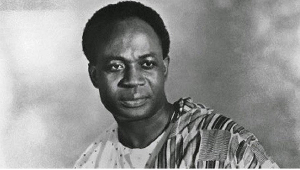
 Ghana's first President, Dr. Kwame Nkrumah
On February 1, 1964, Ghana officially transitioned into a one-party state under the leadership of Kwame Nkrumah and his Convention People’s Party (CPP).
This move followed a constitutional referendum held on January 31, 1964, which solidified the CPP as the sole political party in the country.
Nkrumah argued that a multi-party system was divisive and that a newly independent nation like Ghana needed unity to harness the energy and enthusiasm of its people for national development.
Having studied and lived in both the United States and Britain, Nkrumah believed that traditional Western political systems often served the interests of the wealthy rather than the masses.
In his writings and speeches, he emphasized that a one-party system, when rooted in socialism, could better reflect the collective will of the people and address the needs of the nation as a whole.
He famously stated, "A people's parliamentary democracy, with a one-party system, is better able to express and satisfy the common aspirations of a nation as a whole."
Under Kwame Nkrumah’s leadership, Ghana witnessed remarkable progress in just nine years.
The CPP government built the most modern road network in the country, including the Accra-Tema Motorway, and constructed the Tema Harbour, the largest artificial harbor in Africa.
The Akosombo Dam, a hydroelectric project that created Lake Volta, became a cornerstone of Ghana’s electricity supply and remains vital to this day.
Other achievements included the expansion of telecommunication networks, the provision of free education from primary to university level, and the establishment of state farms, hospitals, and schools.
Despite these advancements, Nkrumah’s government faced criticism and opposition.
On February 24, 1966, just 23 days after he warned of the dangers of a one-party system in a neo-colonial state, Kwame Nkrumah was overthrown in a military coup led by Colonel Emmanuel Kwasi Kotoka and Major Akwasi Afrifa.
The National Liberation Council (NLC) took control, marking the end of Nkrumah’s era.
Kwame Nkrumah’s legacy remains a subject of debate.
While his vision and policies laid the foundation for Ghana’s development, his one-party system and socialist ideals were met with both admiration and resistance.
Today, Ghana’s multi-party democracy continues to shape its political and social landscape.
ID/MA
Meanwhile, watch as chaos erupts at Parliament over vetting of Okudzeto Ablakwa and Mintah Akandoh

Copyright © 1994 - 2026 GhanaWeb. All rights reserved.










