


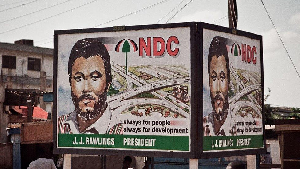
 Billboard of JJ Rawlings
November 3, 1992, remains one of the defining dates in Ghana’s political history, as the country held its first presidential election under the Fourth Republic, paving the way for a return to constitutional multiparty democracy after more than a decade of military rule.
The election brought Flight Lieutenant Jerry John Rawlings, who had ruled Ghana as a military leader, into office as a democratically elected president under the ticket of the National Democratic Congress (NDC).
But Rawlings’ victory was more than an electoral triumph. It marked a significant turning point in Ghana’s political journey, moving the country from military-led administration towards a constitutional system of government.
Rawlings, who had come to power through a military coup on December 31, 1981, had governed Ghana under the Provisional National Defence Council (PNDC) for more than a decade before the transition to multiparty democracy.
His strongest challenger was Professor Albert Adu Boahen, the New Patriotic Party (NPP) candidate and a renowned historian who represented the opposition's push for a change in government.
The final results gave Rawlings 58.4 per cent of valid votes, equivalent to approximately 2.32 million votes, while Adu Boahen secured 30.29 per cent, representing about 1.20 million votes.
Three other candidates also contested the election. Former President Dr Hilla Limann, representing the People's National Convention (PNC), obtained 6.7 per cent; Kwabena Darko of the National Independence Party (NIP) polled 2.86 per cent, while Emmanuel Erskine of the People's Heritage Party (PHP) received approximately 1.76 per cent.
The election, however, was not without controversy. The NPP and other opposition parties questioned the credibility of the results, alleging widespread irregularities in the electoral process. The disputed outcome eventually led the opposition parties to boycott the subsequent parliamentary elections, leaving the NDC and its political allies with an overwhelming majority in Parliament.
International observers, including the Commonwealth Observer Group and the Carter Center, acknowledged shortcomings in the electoral process but did not consider the irregularities sufficient to overturn the presidential result.
The election was part of a broader transition programme announced by Rawlings in March 1992. This included a referendum on a new constitution on April 28, 1992, and the lifting of the ban on political party activities in May that year.
Although the presidential election took place on November 3, 1992, the Fourth Republic was formally inaugurated on January 7, 1993, when Rawlings was sworn in as Ghana's first president under the new constitutional order.
That inauguration marked the beginning of Ghana's Fourth Republic, which has since endured multiple changes of government through successive elections.
More than three decades later, November 3, 1992, remains a defining moment in Ghana's democratic history. It was the day a former military ruler secured an electoral mandate, setting in motion a constitutional era that continues to shape the country's politics.
EA

Copyright © 1994 - 2026 GhanaWeb. All rights reserved.










