



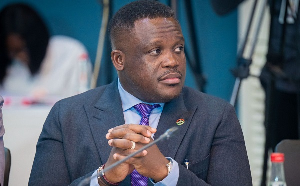
 Samuel Nartey George is the Minister of Communication, Digital Technology and Innovations
Residents of the Keta Municipality in the Volta Region are raising concerns over persistent poor mobile network connectivity, which they say is severely affecting business activities, public services and academic work in the area.
Traders, mobile money vendors, students and officials involved in National Identification Authority (NIA) and National Health Insurance Scheme (NHIS) registration exercises have all complained about unreliable network services, frequent call failures and slow internet connectivity.
Many residents say the unstable network has become a daily source of frustration, disrupting communication, delaying financial transactions and reducing productivity.
Gabriel Sokpoli, a resident of Vui, a suburb of Keta, described the situation as a major challenge for business operators who rely heavily on mobile phones and internet services to communicate with customers and conduct transactions.
“Many business operators in the Municipality are worried about the unreliable network, which is disrupting sales and delaying transactions,” he told the Ghana News Agency (GNA).
“Our phone calls often fail to connect. Messages and mobile money confirmations take too long to arrive. This leaves many customers frustrated, especially when deals and transactions collapse,” he added.
Sokpoli, who also works as a mobile money vendor, said the poor connectivity had negatively affected daily income and reduced productivity among traders and service providers.
According to him, customers often spend long periods attempting to complete transactions, only for the network to fail midway.
He explained that the situation frequently leads to wasted airtime, failed transactions and loss of business opportunities.
“The problem becomes worse during peak business hours when many people are trying to make calls or send money at the same time,” he said.
“The unstable network service has made it difficult to serve customers efficiently, especially in busy market centres and commercial areas.”
Sokpoli further noted that repeated network failures were creating confusion during end-of-day transaction reconciliations for mobile money vendors.
“Some of my colleague vendors have complained that repeated network failures make it hard to reconcile transactions at the end of the day. The delays create confusion between customers and agents, and sometimes customers have to be attended to several times before a transaction is successful,” he stated.
Another resident, Perpetual Ekua Doku, said the poor network connectivity was also affecting social and emergency communication within the Municipality.
She explained that urgent calls often fail to go through, causing anxiety and inconvenience for families and institutions during emergencies.
Doku also disclosed that the unreliable internet service was affecting the ongoing Municipal NHIS registration exercise, which depends heavily on stable connectivity.
According to her, poor network service has led to long wait times and interruptions in service delivery at registration centres.
She added that the NIA was facing similar operational difficulties, as unstable connectivity continued to disrupt biometric registration processes.
Applicants, she said, have experienced repeated delays, failed data uploads and interruptions that force many of them to return on another day to complete their registration.
Some officials involved in the exercises warned that the situation was putting pressure on already overstretched service points and creating growing backlogs.
They cautioned that continued disruptions could discourage residents from completing essential administrative processes.
Some university and nursing training students in the Municipality also complained that unreliable internet connectivity was affecting their ability to register courses, access online academic portals and check examination results.
The students appealed to the relevant authorities to intervene urgently to improve network coverage in the area.
Residents and business operators have therefore called on the Ministry of Communications and Digitalisation, led by Sam George, to take immediate steps to improve network service quality in Keta and surrounding communities.
They believe a stronger, more reliable network coverage would support businesses, improve digital public services, and reduce financial losses for residents.
Meanwhile, frustration continues to mount among residents as they grapple with persistent dropped calls, failed transactions and slow internet connectivity, which many described as part of a broader national telecommunications challenge.

Copyright © 1994 - 2026 GhanaWeb. All rights reserved.










