



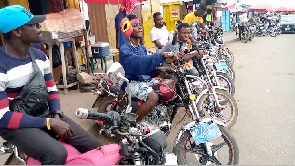
 File photo of Okada riders
The Public Relations Officer of the Ghana Registered Nurses and Midwives Association, Joseph Krampah, has dismissed allegations that motorbike riders injured in accidents are neglected or treated unfairly at health facilities.
His comments come in response to concerns raised by some commercial motor riders, popularly known as "okada" riders, who claim they do not always receive adequate medical attention when involved in road crashes.
Speaking on Adom FM's morning show Dwaso Nsem, on May 25, 2026, Krampah insisted that healthcare professionals are committed to treating all patients equally and that no one is denied care because of their occupation.
“Our job is to save lives, so we cannot say that okada riders will come to the hospital and we will refuse to take care of them or amputate them. That is not what we do,” he said.
He explained that emergency departments follow a triage system, which allows medical staff to assess patients and prioritise treatment based on the seriousness of their injuries rather than the order in which they arrive.
“We have something called triage. When there is an accident or emergency, some cases are more serious than others, so we prioritise based on severity. I don’t know whether they arrive during that sorting process, and that may be why they feel ignored,” he explained.
According to Krampah, patients and their relatives may sometimes misinterpret delays in treatment as neglect, when in reality, healthcare workers are attending to more critical emergencies.
“Because they may not understand what we do, they think we are ignoring them, but that is not the case. We don’t stop everything to attend to one person unless it is life-threatening,” he said.
Addressing claims that some accident victims are unnecessarily subjected to amputations, Krampah clarified that nurses do not perform such procedures and that surgical decisions are made by qualified doctors based on medical assessments.
“We don’t amputate like that. Nurses don’t amputate. Doctors are the ones who perform surgeries. We work within clear guidelines and medical protocols,” he stated.
He further stressed that healthcare delivery in Ghana is governed by professional standards, regulations and continuous oversight to ensure patients receive appropriate care.
“We are trained professionals. There are systems in place, and we follow protocols. Cases are reviewed regularly to ensure proper care,” he said.
Krampah maintained that nurses and midwives remain committed to preserving lives and providing quality healthcare to all patients, regardless of their profession or social background.
He urged the public to have confidence in the healthcare system and to seek clarification whenever concerns arise about the treatment process.
NA/VPO

Copyright © 1994 - 2026 GhanaWeb. All rights reserved.










