


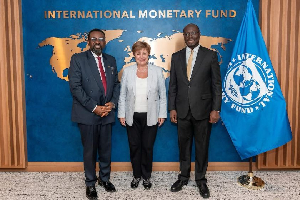
 The mission is also expected to examine Ghana's debt position, expenditure management and more
An International Monetary Fund (IMF) mission team is expected to hold discussions with the government on Ghana’s fiscal performance, revenue mobilisation, monetary policy and preparations for the 2027 Budget as it begins a two-week visit to the country.
The discussions, which begin from Thursday October 22, 2026, are expected to focus on economic performance during the first nine months of 2026 and the policies needed to sustain recent economic gains.
The mission is also expected to examine Ghana’s debt position, expenditure management for the remainder of the year and the government’s spending plans for 2027, particularly its proposed infrastructure investments.
Revenue mobilisation is likely to be a key issue as the government seeks to strengthen public finances while maintaining macroeconomic stability.
On the monetary front, discussions are expected to cover Ghana’s inflation-targeting framework, monetary policy and foreign exchange arrangements.
The mission could also assess the Bank of Ghana’s financial position, international reserves and measures to safeguard the central bank’s independence.
Initial engagements are expected to involve officials from the Ministry of Finance and the Bank of Ghana, with other key economic stakeholders likely to participate during the visit.
Ghana’s PCI programme
The mission team, led by Dr Ruben Atoyan, forms part of Ghana’s engagement with the IMF under the Policy Coordination Instrument (PCI), a non-financing framework intended to consolidate economic gains and sustain policy reforms.
The IMF Executive Board completed the sixth and final review of Ghana’s Extended Credit Facility (ECF) arrangement on July 27, 2026, and considered the country’s request for a 36-month PCI.
Unlike the ECF, the PCI does not provide direct financial assistance. Instead, it offers a framework for the government to demonstrate progress on its economic policy commitments and strengthen confidence among investors and development partners.
Minister of Finance Dr Cassiel Ato Forson has previously described the framework as an anchor for Ghana’s next phase of reforms, aimed at strengthening economic resilience and supporting broad-based growth.
He explained that the programme would help preserve the gains made under IMF-supported reforms while reinforcing policy credibility and investor confidence.
What the PCI means for Ghana
The PCI allows countries to maintain close policy engagement with the IMF without receiving financing under the instrument.
It supports the design and implementation of economic reforms while signalling a country’s commitment to sound economic policies to development partners and private investors.
Its objectives include strengthening macroeconomic stability, addressing underlying economic imbalances and building resilience against economic shocks.
Although the instrument provides no direct funding, it requires countries to implement policies that meet standards comparable to those under IMF lending arrangements.
The IMF assesses a country’s performance through reviews conducted on a fixed schedule, typically every six months.
The instrument also requires approval by the IMF Executive Board, distinguishing it from a Staff-Monitored Programme, which is an informal arrangement between IMF staff and a member country.
MA
Inside Ghana’s First 950,000-Barrel Sankofa Oil Shipment | Exclusive Tour

Copyright © 1994 - 2026 GhanaWeb. All rights reserved.










