



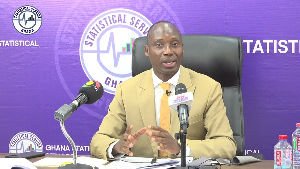
 Dr Alhassan Iddrisu is the Government Statistician
Multidimensional poverty in the country declined to 21.9 percent in the third quarter of 2025, confirming steady national improvement in living conditions.
However, sharp regional, rural-urban and social inequities persist, the latest Multidimensional Poverty Index (MPI) Statistics Bulletin released by the Ghana Statistical Service (GSS) shows.
This represents a reduction from 23.9 percent in Q1 2025 and 23.1 percent in Q2 2025, with GSS estimating that more than 360,000 people exited multidimensional poverty between the second and third quarters alone.
On a year-on-year basis, about 950,000 people moved out of multidimensional poverty between Q3 2024 and Q3 2025.
The MPI measures deprivation or poverty beyond income, capturing access to health, education, living conditions and employment through 13 indicators including sanitation, housing quality, nutrition, health insurance, school attendance and job security.
Producer Price Inflation climbs to 1.9% in December 2025 - GSS.
Speaking at the bulletin’s release, Government Statistician, Dr Alhassan Iddrisu, said the data show that while national progress is encouraging, “poverty in Ghana remains uneven and deeply shaped by where people live, their education levels and access to basic services”.
He noted that the MPI supports national development priorities – including protecting livelihoods, expanding opportunity and strengthening social protection – while aligning with the Sustainable Development Goals of ending poverty and leaving no one behind.
Regional and rural-urban gaps
Despite national improvement, regional disparities remain stark. The North East and Savannah Regions recorded poverty incidence above 50 percent – more than double the national average of 21.9 percent, while the Greater Accra and Western Regions maintained rates below 20 percent.
In absolute numbers, highly populated regions host large numbers of poor people even when incidence rates are moderate.
The Ashanti and Northern Regions recorded the largest numbers of multidimensionally poor persons, each exceeding one million – reflecting population size and concentrated deprivation in Q3 2025.
The rural-urban divide also remains wide: rural poverty reached 31.9 percent in Q3 2025 compared with 14.2 percent in urban areas, creating an 18 percentage-point gap.
GSS stressed that while national poverty is falling, rural communities continue to bear a heavier burden – underscoring the need for targetted investments in infrastructure, sanitation, livelihoods and service delivery.
Key drivers of poverty
Health and living conditions remain the dominant contributors to multidimensional poverty, accounting for 40.9 percent and 33.8 percent respectively. Major drivers include health insurance coverage (26.5 percent), poor nutrition (14.4 percent), overcrowding, inadequate sanitation and weak housing quality.
Education and employment are critical protective factors, as households headed by persons with no formal education recorded poverty incidence of 38.5 percent compared with just 5.7 percent among those whose heads attained tertiary education.
Employment quality also matters: “Households headed by unemployeds consistently face the highest poverty, peaking at 35.6 percent in Q3 followed by those in the private informal sector (above 22 percent).
“Poverty among households where the household head is a public sector worker declined from 7.7 percent in Q2 to 5.3 percent in Q3.”
By economic sector, poverty was highest among households headed by workers in agriculture (32.1 percent) compared with industry (9.8 percent) and services (9.7 percent), reinforcing calls for agricultural modernisation and stronger agro-processing value chains.
Vulnerable groups and compound risks
The report highlights heightened vulnerability among persons with disabilities, households in informal unions and some female-headed households.
“Households headed by persons living together or in informal unions recorded the highest poverty incidence (33.1%) in Q3 2025. Poverty declined among divorced and separated household heads, but widowed and never-married heads saw increases,” GSS noted.
Households headed by persons with hearing or intellectual difficulties recorded poverty incidence of 43 percent and 33.6 percent respectively, well above the national average.
GSS also examined overlapping risks of poverty, unemployment and food insecurity – indicating that about 227,500 people (1.5 percent) aged 15 years and above experienced the triple burden in Q3 2025, slightly higher than the previous quarter.
While the number of people facing both poverty and food insecurity declined to 3.6 million, the population facing both poverty and unemployment increased to roughly 483,000 – signalling labour market pressures despite overall poverty reduction.
Greater Accra, Ashanti and Central Regions together accounted for about 57 percent of the triple-burden population.
“The population 15 years and older who suffered the triple burden of food insecurity, unemployment and multidimensional poverty in Q3 2025 are predominantly residing in Greater Accra (53,700), Ashanti (37,700) and Central (37,000). The three regions account for about 57 percent of the total population 15 years and older with a triple burden in Q3 2025.
“Oti Region has the least number of triple-burdened population (1,100),” it stated.
Policy direction
GSS recommended expanding national health insurance coverage, improving sanitation infrastructure, strengthening school feeding and education support programmes, scaling up skills development and job creation and targetting interventions geographically and socially.

Copyright © 1994 - 2026 GhanaWeb. All rights reserved.










