



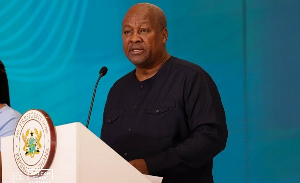
 President John Dramani Mahama
President John Dramani Mahama has lauded the establishment of the Ghana Gold Board (GoldBod), describing it as a critical step towards strengthening Ghana’s control over its natural resources.
The GoldBod is the sole authority with exclusive rights to buy, sell, weigh, grade, assay, value, and export gold and other precious minerals in Ghana.
According to the President, by exercising greater sovereignty over its natural resources, the establishment of the Ghana Gold Board has given the government enhanced control over gold exports.
“In 2024, total gold exports from the small-scale mining sector were projected to reach 63 tonnes,” President Mahama said in his remarks at the Africa Trade Summit 2026 in Accra.
“Of this volume, foreign exchange repatriation accounted for only about 40 tonnes of exported gold. Of that amount, the foreign exchange proceeds from 23 tonnes did not return to the country,” he explained.
President Mahama noted that since the establishment of the Gold Board in April 2025, exports from the small-scale mining sector have increased to 104 tonnes, with 100 percent of the foreign exchange fully repatriated through the Central Bank.
He also indicated that Ghana was increasing the participation of indigenous Ghanaian companies in mining and other natural resource extraction activities.
The President said local content laws had been passed, making it mandatory for non-Ghanaian investors to partner with local companies in all mining and extractive investment activities.
“Industrialisation cannot succeed within fragmented national markets. Africa’s future lies in regional value chains,” President Mahama stated.
“Not every country can produce everything, but together we can build competitive industries across our borders, where raw materials, intermediate goods, and finished products move seamlessly within our regions. This is how other regions have industrialised.”
To support this vision, the President said Africa must invest in transport corridors, energy grids, and digital infrastructure, while harmonising standards and regulations, stressing that industrial integration requires market integration.
He described the African Continental Free Trade Area (AfCFTA) as the most ambitious integration project in the history of the African continent.
According to him, by creating a single market of over 1.3 billion people, the AfCFTA provides the scale African industries have long lacked to expand, transforming the continent into a viable manufacturing and investment destination.
President Mahama noted that Ghana was proud to host the Secretariat of the continental body and to be among the early adopters of trading under its preferences. However, he cautioned that the AfCFTA would not automatically industrialise Africa.
He reiterated that the initiative must be deliberately linked to industrial policy, infrastructure investment, and enterprise development.
The President stressed that reducing non-tariff barriers, simplifying customs procedures, improving logistics, and investing in digital trade infrastructure were essential for the AfCFTA to deliver on its promise.
President Mahama said Ghana’s experience reinforced key lessons, noting that industrialisation works when policies are deliberate, infrastructure is reliable, skills are developed, and macroeconomic stability is maintained.
He added that investor confidence thrives when institutions are strong and policies are predictable, emphasising that Africa’s industrial transformation cannot be achieved by governments alone.
“Governments must provide leadership and stability. The private sector must invest and innovate. Financial institutions must design long-term financing solutions, and development partners must align with Africa’s priorities,” he said, underscoring the need for African institutions to coordinate and remove barriers to integration.

Copyright © 1994 - 2026 GhanaWeb. All rights reserved.










