



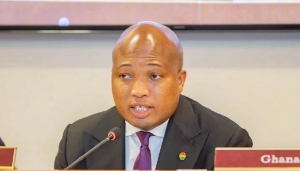
 Samuel Okudzeto Ablakwa is Minister of Foreign Affairs
Foreign Affairs Minister, Samuel Okudzeto Ablakwa, has described President John Dramani Mahama’s deliberate choice of the traditional Fugu attire as a symbolic revival of the “African Personality” championed by Ghana’s first President, Osagyefo Dr Kwame Nkrumah.
Speaking at the Zambia–Ghana Dialogue in Lusaka, Ablakwa said the President’s dressing had generated significant public interest in both Ghana and Zambia, sparking renewed conversations around African identity, dignity, and culture.
“From the outset, let me advertise my President’s favourite attire, the fugu,” Ablakwa said. “We are all excited about the buzz that the President’s deliberate choice of apparel has created.”
According to him, the attention surrounding the attire represents a broader cultural reawakening rooted in Africa’s historical struggle for identity and self-definition. He explained that reclaiming African culture was central to the vision of Ghana’s founding president and other early Pan-African leaders.
“It has triggered a renaissance in what Osagyefo Dr Kwame Nkrumah described as the African Personality – that we should reclaim the African identity, the African dignity and the African culture,” Ablakwa stated.
He noted that discussions about restitution and reparations for the transatlantic slave trade should go beyond financial compensation to include a conscious effort to reconnect with Africa’s cultural roots, traditions, and sense of self.
“They did not only seek to enslave us; they sought to rob us of our unique identity, our unique dignity, and our unique traditions,” he said.
Ablakwa recalled that the Fugu was worn by Dr Kwame Nkrumah on March 6, 1957, when Ghana became the first African country to gain independence. He said Nkrumah used that moment to declare that Ghana’s independence was meaningless unless it was linked to the total liberation of the African continent.
He further highlighted the historical ties between Ghana and Zambia, noting that Zambia’s founding president, Kenneth Kaunda, worked closely with Nkrumah during Africa’s independence struggles. Ghana, he said, became the first African country to formally recognise Zambia’s independence in 1964 and establish diplomatic relations.
Touching on economic cooperation, Ablakwa encouraged African businesses, particularly FinTech companies, to support the cultural renaissance by facilitating the movement of African fabrics and traditional wares across borders. He specifically mentioned opportunities for linking Ghanaian Fugu makers, many of whom are young women, with markets across Zambia and the wider continent.
He also referenced Ghana’s role as host of the African Continental Free Trade Area (AfCFTA), describing it as the realisation of the vision of Africa’s founding leaders to promote unity and intra-African trade. However, he noted that Africa currently records less than 20 per cent intra-continental trade, according to UNCTAD figures.
Ablakwa expressed hope that the Ghana–Zambia Business Forum would help change that narrative, stressing that both President Mahama and Zambian President Hakainde Hichilema were focused on results rather than ceremonial engagements.
“They want real impact; impact measured by industrialisation, job creation, and the prosperity of our people,” he said, adding that Africa’s natural resources must be harnessed to serve its people and project dignity and pride.

Copyright © 1994 - 2026 GhanaWeb. All rights reserved.










