



 The monitoring exercise commenced at the Accra Mall before other places
As part of efforts to sustain Ghana’s clean environment agenda, the Ministry of Local Government, Chieftaincy and Religious Affairs, on Saturday, February7, 2026, monitored sanitation activities across selected Municipal Assemblies during the February National Sanitation Day (NSD) exercise in the Greater Accra Region.
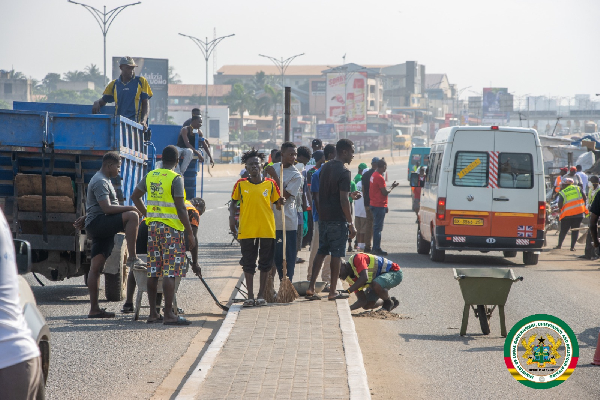
The monitoring exercise commenced at the Accra Mall, after which the Ministry’s team proceeded to the Ayawaso West Municipal Assembly, covering areas including Fiesta Royal, the National Petroleum Authority (NPA) enclave, and sections of the N1 Highway towards Lapaz.
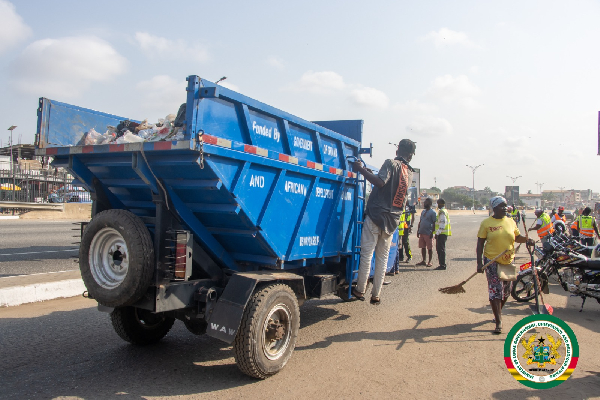
At Ayawaso West, sanitation activities were ongoing with support from Assembly officials, and some hawkers were observed voluntarily joining the clean-up exercise.
However, the team noted heaps of gathered sand and debris that had not yet been carted away. Officials from the Ministry drew the attention of the Municipal Assembly to the issue and urged immediate action to ensure the proper evacuation of waste.
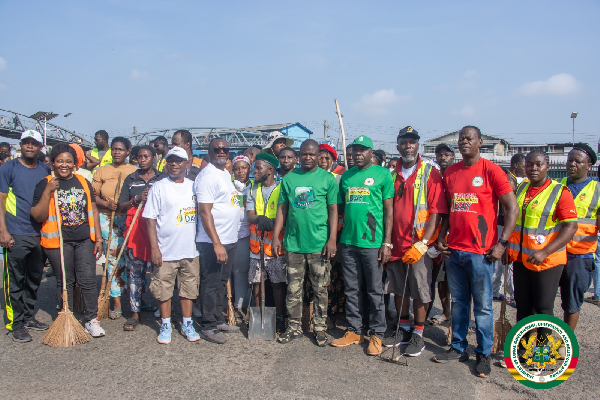
The team later moved to the Okaikwei North Municipal Assembly at Lapaz, where participation was observed to be encouraging. Shops were largely closed during the exercise, while traders, residents and Assembly staff actively engaged in cleaning activities.
The Municipal Chief Executive and other Assembly officials were visibly present, coordinating and supporting the exercise, a development described by the Ministry as commendable.
Monitoring further extended through Awoshie and Baahyard under the Ablekuma North Municipal Assembly, where participation was relatively good, with sanitation teams and residents working within their respective communities.
At the Ablekuma West Municipal Assembly, particularly around Dansoman Last Stop and its environs, Assembly staff were actively engaged in desilting drains and undertaking other sanitation-related works, with support from some community members.
Despite these positive observations, the Ministry identified a key concern across most locations, the generally low participation of the wider public.
In many instances, the exercise appeared to be driven largely by the District Assemblies, with only a limited number of residents taking part.
Commenting on the observations in a statement, the Ministry reiterated the need for stronger citizen ownership of the initiative, stressing that sanitation is a collective national responsibility.
Minister explains why government seeks to amend Chieftaincy Act
“National Sanitation Day is not an Assembly activity alone. Every Ghanaian has a role to play in keeping their environment clean, starting from their homes and immediate surroundings.”
The Ministry reminded the public that every first Saturday of the month has been declared National Sanitation Day by the President John Dramani Mahama and called on citizens to actively participate by cleaning their frontages, desilting drains and dustbins and maintaining clean surroundings, while Assemblies facilitate supervision and the carting of debris.
The Ministry emphasised that sustained public participation and shared responsibility remain critical to achieving cleaner cities and healthier communities, as the National Sanitation Day exercise continues across the country.
Meanwhile, watch the excitement, divisions over Agradaa’s reduced sentence

Copyright © 1994 - 2026 GhanaWeb. All rights reserved.










