



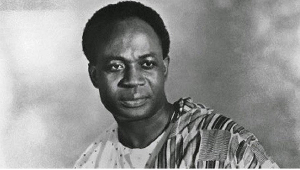
 Dr Kwame Nkrumah is Ghana's first president
Why the persistent interest in renaming Kotoka International Airport? The answer is straightforward: the name Kotoka unsettles John Mahama’s conscience, the self-styled acolyte whose “reset agenda” mirrors the authoritarian instincts of those who would be dictators. His actions, and those of his supporters, continue to weaken the already fragile bonds that have failed to unite us since independence in 1957.
To ignore the facts of Kwame Nkrumah’s authoritarian regime is to abandon Ghana’s ongoing quest for individual freedom. If Nkrumah’s authoritarianism is dismissed as a mere invention of his detractors, then truth itself collapses. Without truth, there can be no critique of political abuse—only spectacle. And in such a spectacle, the largest bloc in Parliament controls the purse that pays for the brightest lights.
This authoritarian trajectory culminated in Nkrumah’s downfall. On February 24, 1966, while he was on an official visit to China, a military coup ended his rule. His supporters, for obvious reasons, branded the coup illegitimate. The new leaders formed the eight-member National Liberation Council, dissolved the Convention People’s Party (CPP), and suspended the one-party constitution.
As Ghana’s first president, Nkrumah launched ambitious economic projects, many of which proved unsustainable. The economy faltered, and in his bid to regain control, he tightened his grip on currency, raised taxes, and pursued nationalization—all in service of an industrialized socialist vision. By 1963, shortages and inflation had eroded public confidence. Facing growing opposition, Nkrumah turned to repression.
The Preventive Detention Act allowed him to jail critics without trial for up to five years. In 1964, he staged a referendum — heavily rigged — that cemented the CPP as the sole legal party and himself as president for life. Parliament became a rubber stamp, and Nkrumah dismissed Chief Justice Sir Arku Korsah, pushing through legislation that made him the final arbiter of all legal cases. Press freedom collapsed, silencing dissent.
The CPP, acting as a political monolith, sought to impose socialism on a resistant populace. Citizens opposed this concentration of power, preferring liberty under democracy to the suffocating grip of a one-party state. Resistance grew, sometimes violently, as Nkrumah’s regime met protest with force and opponents responded in kind. Violence scarred both sides.
We must not tell a history that absolves Nkrumah and the CPP of their excesses. To do so is to erase the sacrifices of ordinary Ghanaians who demanded true freedom and liberty, and to forget that authoritarianism — whether cloaked in nationalism or socialism — remains democracy’s most enduring threat.
Kwame Nkrumah’s appeal lay in a false vision of liberty or law and in the real emotional rewards of tribal combat and the spectacle of a leader who punished the tribe’s enemies. Nkrumah exercised power on his personal whim, unchecked by other branches or organs of government. What happened under his rule was not ordinary partisan conflict but the definition of dictatorship itself — a system in which power was concentrated in a single person.
Why All This History?
Why all this history? Why not simply focus on current policy issues? There are reasons. First, we study events such as the 1966 coup to remind ourselves: Never again. Never again must such authoritarian excesses be allowed to take root. The study of history is our best guide to the present and the future. Freedom is best defended when philosophical claims are anchored in historical truth.
Kotoka’s 1966 coup was not about factories, Tema motorway, the Akosombo dam, or the economy per se; it was about freedom and liberty. It was about the individual’s right to pursue happiness, the importance of the family, religious affiliations, private enterprises, and voluntary organizations in preserving liberty, and the dangers of unchecked power. It was about the necessity.

Copyright © 1994 - 2026 GhanaWeb. All rights reserved.










