



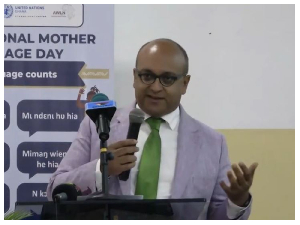
 Zia Choudhury is UN Resident Coordinator for Ghana
The United Nations Resident Coordinator for Ghana and an advocate for multilingual education, Zia Choudhury, has urged the youth of Ghana to take the lead in protecting and promoting mother tongues, describing language as central to identity, culture and national development.
Speaking at the International Mother Language Day at the University of Ghana on Wednesday February 25, 2026, he explained why the date February 21 holds deep personal and historical significance.
“February 21 is not just a date on the calendar for us. It is a day that reminds tens of millions of Bangladeshis of the sacrifices made to defend our mother tongue,” he stated.
Reflecting on the meaning of a mother tongue, Choudury noted that it goes beyond the first language learned at home.
“It is the sweet language our mothers used to tell us stories, sing songs, or whisper messages of love to us,” he said.
“Those first words shaped our minds, our culture and our very souls,” he added.
Choudhury recounted how in 1948, authorities in the then Pakistan declared ‘Urdu’ the sole national language, effectively downgrading ‘Bangla’, a language spoken by millions in what is now Bangladesh.
“Imagine your mother tongue being ridiculed and pushed aside in favour of a language from a distant land,” he said.
Professor Wiafe urges stakeholders to leverage AI to safeguard local dialects
“History shows us that language has often been used as a tool of power and control,” he added.
That decision sparked widespread resistance, culminating in the fatal shooting of student protesters on February 21, 1952.
“Young people demanding recognition of their mother tongue were killed by police,” he recounted.
“Many brave men and women risked imprisonment and even death simply to say, ‘I speak Bangla,” he added.
The movement eventually contributed to Bangladesh’s independence, and February 21 became a National Day of Mourning.
In the 1990s, however, Bangladesh proposed to the United Nations that the date be recognised globally to celebrate linguistic diversity.
“In 2000, UN member states unanimously agreed, and it became International Mother Language Day,” he said.
Highlighting this year’s theme, “Youth Voices on Multilingual Education,” he stressed the importance of inclusive learning.
“Forty percent of learners worldwide still do not receive education in a language they understand best,” he noted, citing UNESCO data.
“These language barriers deepen inequality, particularly for rural and marginalised children,” he added.
Zia Choudhury commended Ghana for championing the use of mother-tongue as mode of instruction from kindergarten to primary three, describing it as a step in the right direction.
At the same time, attention was drawn to the digital era, where emerging technologies such as artificial intelligence present both risks and opportunities.
“AI can be a threat, but we can also use it to our huge advantage. The potential is massive if we use it wisely,” he stated.
Choudhury urged greater engagement with young people to drive decisions that directly impacts them.
“Let’s support the young people, listen to them, and learn from their skills and experiences. Languages build inclusive societies, strengthen cooperation and preserve our shared cultural heritage,” he said.
SO/VPO
Ghanaian man and his Nigerian girlfriend found dead in Morocco apartment

Copyright © 1994 - 2026 GhanaWeb. All rights reserved.










