



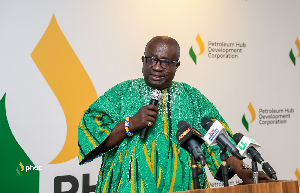
 Dr Toni Aubynn is the CEO of Petroleum Hub Development Corporation
The Petroleum Hub project, a planned petrochemical complex in Jomoro, is designed to transform Ghana into a resilient regional energy powerhouse and reduce the country’s reliance on imported petroleum products.
Currently, Ghana spends approximately US$3 billion annually importing refined petroleum products, despite being a crude oil producer.
To address this dependency, the government established the Petroleum Hub Development Corporation (PHDC) under the PHDC Act, 2020 (Act 1053). The corporation’s mandate includes promoting investment, facilitating investor relations, providing aftercare and advocacy, developing the hub, and preparing an industry-ready workforce to drive its implementation and growth.
Speaking on the project’s progress, the Chief Executive Officer of PHDC, Dr Toni Aubynn, noted that land acquisition is a critical component of the initiative.
He said compensating landowners is a key pillar of the government’s strategy to position Ghana as a regional petroleum and petrochemical hub.
7 ways to harness your instincts to grow your business faster
During a media engagement following a strategic meeting with Civil Society Organizations on Wednesday, March 4, 2026, Dr Aubynn disclosed that approximately US$100 million will be required to compensate affected landowners.
He explained that the project covers 13,000 acres of land, equivalent to about 5,000 hectares.
“Because of the reduction in the size of the land, we have to recompute the figures for compensation, but we are looking at around GH¢900 million. Between GH¢800 million and GH¢900 million, which in dollar terms is about US$100 million,” he said.
Dr Aubynn added; “My minister is working hard to fashion a model that can begin to pay the compensation. You don’t need to pay everything at once, but there should be a framework that commits the entity to pay compensation.”
At full operational capacity, Ghana’s petroleum hub refineries are expected to significantly reduce the country’s dependence on imported petroleum products, helping save critical foreign exchange during global supply disruptions.
With three refineries providing a combined capacity of 900,000 barrels per day (bpd), Ghana will be able to refine its own crude oil to meet 100 percent of domestic demand.
SA/MA
Auto dealers respond to 15% price cut announcement

Copyright © 1994 - 2026 GhanaWeb. All rights reserved.










