



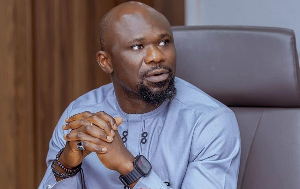
 Onasis Kobby is one of the notable persons who have spoken on the issue
As tensions escalate in the US-Israel-Iran corridor, a growing number of political analysts and public figures are drawing parallels between the Middle Eastern crisis and the ongoing Russia-Ukraine war.
While some caution against equating the two crises, others highlighted contradictions in how the NDC party have linked the conflict to economic impact in the past.
This listicle highlights notable persons who have spoken out on the issue.
Felix Kwakye Ofosu
First on the list is Felix Kwakye Ofosu, Minister of State in charge of Government Communications.
In a Channel One TV interview, Kwakye Ofosu (then in opposition) explained that the Russia‑Ukraine war worsened an already fragile economy under President Akufo‑Addo. Before the war, inflation stood at 13.7%, but it rose to 15.7%. The fiscal deficit was 15%, and 92% of tax revenue went toward debt servicing.
In recent times, Kwakye Ofosu argues that Ghana’s fundamentals under President Mahama are more stable and better positioned to absorb shocks from fluctuations in Middle Eastern oil prices.
“Don’t compare the Russia‑Ukraine war under the Akufo‑Addo administration to the US‑Israel conflict under President Mahama; the dynamics are different,” he said.
He explained that each global conflict carries unique economic consequences and should be assessed within its own context.
Musah Superior
Also, former Tamale Mayor Musah Superior has also reacted to the debate, questioning Mahama’s current warnings about the Middle East tensions.
According to him, these warnings contradict Mahama’s earlier position, when he dismissed the Russia‑Ukraine war’s impact on Ghana’s economy.
“If the Russia‑Ukraine war didn’t shake Ghana, then the Middle East crisis won’t either,” he said.
Musah Superior maintained that this shift in Mahama’s stance undermines his credibility, suggesting that the explanation offered by the president (when he was in opposition) is inconsistent with how he frames the effects of global conflicts on Ghana’s economic stability now.
He added that Mahama’s shifting of the goal post on such sensitive topics undermines his credibility.
Kwadwo Poku
Kwadwo Poku, a member of the NPP National Communications Team, has also reacted to the debate.
Speaking in an interview on Accra‑based GHOne TV on Monday, March 9, 2026, he criticised the NDC for what he described as inconsistency in handling global crises.
He stated that while in opposition, the NDC dismissed the impact of external shocks such as the Russia‑Ukraine war, yet now warns about the consequences of Middle East tensions.
For Poku, their posture highlights what he sees as political opportunism.
“In opposition, the NDC did unnecessary politics, okay? And karma is real,” he said.
Some NPP communicators and MPs have also echoed similar sentiments in recent debates, terming Mahama’s current warnings as a “dramatic shift” from his earlier position.
They argue that while the NDC previously rejected claims that the Russia-Ukraine war and COVID-19 affected Ghana’s economy, Mahama now acknowledges that external conflicts can pose serious risks to a country’s economy.
Onasis Kobby
Beyond political figures, analysts such as Onasis Kobby, the Deputy Chief Executive Officer in charge of Operations and Technical at the Petroleum Hub Development Corporation (PHDC), have also highlighted the differences between the two conflicts.
Speaking in an interview with Okay FM on Monday, March 9, 2026, he outlined several reasons to support his claim that the Russia-Ukraine war is a minor factor compared to the current conflict ongoing in Iran.
He argued that the Middle East crisis, with Iran at its center, represents a significantly more potent threat to global market stability than the Russia-Ukraine war, primarily due to its potential to paralyse critical energy corridors.
“Our trade with Ukraine is mainly in grains. What people don’t know is that the Russia-Ukraine conflict was supposed to benefit us. Because of that war, Russia was selling crude oil at very low prices. Countries were buying from Russia at discounted rates to refine, so we were supposed to gain."
"How many of our traders go to Ukraine to trade? But we all know that our traders mainly go to China, India, and Dubai to buy goods. Aviation in the UAE has been halted, so you can imagine the impact on us. Anyone who says the Russia-Ukraine war is the same as the ongoing conflict in Iran is either being ignorant or engaging in partisan politics," he added.
VKB/VPO
Citizens speak on GoldBod Jewellery-Nana Aba Anamoah partnership

Copyright © 1994 - 2026 GhanaWeb. All rights reserved.










