



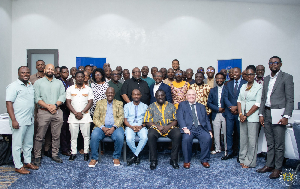
 A group photo of participants after the workshop
The Cyber Security Authority (CSA) in collaboration with Vice-Chancellors’ Ghana (VCG) has organised a capacity-building workshop for the Vice-Chancellors of the public Universities in Ghana to strengthen cybersecurity leadership and resilience within Ghana’s tertiary education sector.
It was organised in partnership with the Forum of Incident Response and Security Teams (FIRST) to enhance understanding of the evolving cybersecurity landscape affecting higher education institutions and equip participants with the know-how to mitigate cyber threats.
The acting Deputy Director-General in charge of Regulatory Operations, Dr Jamal Seidu Tozua, speaking on behalf of the Director-General of the CSA, Divine Selase Agbeti, highlighted the growing cybersecurity risks facing educational institutions and emphasised the need for strong cyber hygiene practices across Universities.
He urged Vice-Chancellors to strengthen the technical capacity of their IT departments and enhance collaboration with the National Computer Emergency Response Team (CERT-GH) to reduce institutional exposure to cyber risks.
Dr Tonzua further urged tertiary institutions to support efforts towards establishing an Education Sector Computer Emergency Response Team (CERT) to facilitate coordinated threat detection, response, and information sharing within the sector stressing the need for institutions to engage only licensed and accredited cybersecurity service providers when procuring cybersecurity services.
He averred that the CSA was collaborating with the Ghana Tertiary Education Commission (GTEC) to embed cybersecurity as a key pillar in Ghana’s higher education system.
The Director for Corporate Affairs at the Ghana Tertiary Education Commission (GTEC), Jerry Sarfo, speaking on behalf of the Director-General, Prof Ahmed Jinapor Abdulai, noted that the tertiary education sector had become an attractive target for cybercriminals due to the vast amounts of sensitive personal, financial, and intellectual property data managed by the institutions.
He urged tertiary institutions to consciously embed a culture of cyber resilience in their institutions.
The Chair of Vice-Chancellors’ Ghana, Prof Richard Kwasi Amankwah, commended the CSA for the engagement and called for sustained collaboration between the Authority and tertiary institutions.
The training sessions were facilitated by officers from the CSA, the Shadowserver Foundation, and FIRST.
Participants were taken through emerging cyber threats affecting educational institutions, including online fraud, impersonation, phishing, unauthorised access, and the exposure of institutional data on the dark web.
The Vice-Chancellors were further taken through cybersecurity governance frameworks and regulatory obligations.
The workshop also featured a tabletop simulation exercise where the University leadership responded to a ransomware attack scenario designed to test leadership coordination, crisis decision-making, and incident response readiness.
As part of the broader capacity-building initiative, a specialised technical workshop was subsequently organised for IT Directors and Cybersecurity Leads from tertiary institutions.
Participants were led through vulnerability management practices, including the use of vulnerability scanning and monitoring tools to identify, assess and remediate security weaknesses within University networks and digital infrastructure.

Copyright © 1994 - 2026 GhanaWeb. All rights reserved.










