



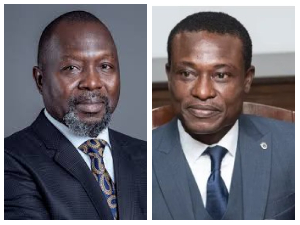
 Dominic Akuritinga Ayine (L) and Kissi Agyebeng (R)
The ongoing constitutional battle is gathering steam at Supreme Court, as the Attorney-General (AG) Dominic Ayine has aligned with arguments challenging the prosecutorial authority of the Office of the Special Prosecutor (OSP), raising fundamental questions about the limits of Parliament’s power and the interpretation of the 1992 Constitution.
Although the Attorney General is formally listed as the defendant in the case, court filings reveal that he intends to support key aspects of the suit specifically the claim that the OSP’s power to independently prosecute criminal cases is unconstitutional.
Core of the Constitutional Argument
At the heart of the dispute is Article 88 of the 1992 Constitution, which the AG argues vests exclusive prosecutorial authority in his office.
In a draft statement of case attached to a motion filed on April 8, 2026, the AG contends that this constitutional mandate cannot be altered by ordinary legislation.
According to the AG, while Article 88(4) allows the Attorney General to delegate prosecutorial powers, the law establishing the OSP; the OSP Act, 2017 (Act 959) goes further by effectively transferring, rather than delegating, that authority.
He argues that this creates a structural problem in the sense that, instead of the AG maintaining oversight, the OSP operates with what he describes as ‘insulated’ prosecutorial powers, undermining constitutional intent.
From Delegation to ‘Donation’ of Power
$65K Bond, Electronic Monitor: Lawyer shares new details on Ofori-Atta's release
A central plank of the AG’s argument is that Act 959 transforms delegation into what he terms a “donation” of power.
In practical terms, he claims the law compels the Attorney General to step back from prosecuting certain offences, leaving the OSP to act independently.
This, he argues, weakens key constitutional controls.
Tools such as plea bargaining and the power to enter a nolle prosequi, mechanisms traditionally used by the Attorney General to oversee prosecutions are no longer effectively applicable where the OSP acts autonomously.
The implication, according to the AG, is that Parliament has indirectly stripped his office of essential prosecutorial functions without undertaking a constitutional amendment.
Parliament’s Authority Under Scrutiny
The AG further contends that Parliament exceeded its constitutional authority by enacting Act 959 in its current form.
He argues that any significant alteration of prosecutorial powers especially one affecting constitutional offices must be done through a formal amendment process, not ordinary legislation.
By attempting to redefine prosecutorial authority through statute, the AG maintains that Parliament has acted inconsistently with the constitution, rendering portions of the law invalid.
Lawyer details real reason for Ken Ofori-Atta's release from ICE detention
Origins of the Case
The suit was initiated in December 2025 by private legal practitioner Noah Ephraem Tetteh Adamtey, who is asking the Supreme Court to interpret whether the OSP’s prosecutorial mandate complies with constitutional provisions.
Among the reliefs sought is a declaration that Act 959 is unconstitutional to the extent that it grants the OSP independent prosecutorial authority.
The suit also challenges specific provisions particularly Sections 3(3) and 4 arguing that they unlawfully remove the Attorney General’s control over criminal prosecutions.
What Is at Stake
The case presents a far-reaching constitutional question: can an independent anti-corruption body exercise prosecutorial powers separate from the Attorney General, or must all such authority ultimately remain under the AG’s control?
The Supreme Court’s eventual ruling could redefine the operational boundaries of the OSP and reshape Ghana’s anti-corruption architecture.
It may also clarify the extent to which Parliament can legislate on matters already governed by explicit constitutional provisions.
For now, the AG has sought additional time to formally file his full statement of case, signaling that a detailed constitutional showdown lies ahead.
MRA/VPO
RNAQ Divorce: Court awards ex-wife GH¢300k, dismisses GH¢50m settlement claim

Copyright © 1994 - 2026 GhanaWeb. All rights reserved.










