



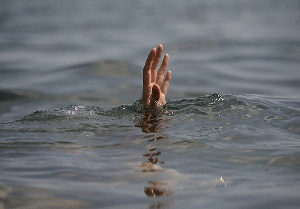
 File photo of a person drowning
Ghana is set to roll out a national Lifeguarding Initiative for drowning prevention as authorities move to confront what experts describe as a “largely overlooked but deadly public safety crisis.”
This was contained in a statement issued by the project partners on April 10, 2025.
“The Kwame Nkrumah University of Science and Technology (KNUST) and the Johns Hopkins International Injury Research Unit (JH-IIRU), in collaboration with the National Coordination Board (NCB) for Drowning Prevention, have announced plans to officially launch the Lifeguarding Initiative for Drowning Prevention in Ghana on 14 April, 2026," it stated.
14-year-old JHS student drowns in Gomoa Nyanyano
The initiative is expected to significantly reduce drowning incidents across the country through a comprehensive, evidence-based approach that integrates prevention, surveillance, and emergency response systems.
Authorities estimate that about 1,400 people die from drowning annually in Ghana, with incidents recorded at beaches, inland waterways, septic tanks, and domestic settings.
“Drowning incidents in Ghana occur across diverse settings, including coastal beaches, inland water transport routes, recreational swimming areas, septic tanks, and domestic settings, disproportionately affecting children and other vulnerable populations.
“Swimming is the leading activity nationwide that leads to drowning deaths. Along ocean beaches, over 70 percent of drownings occur when people are swimming. The fatal drowning rate in the Accra metropolitan Area is over twice the national average, and disproportionately high among adolescents, who make up the majority of beachgoers“, the statement noted.
The launch of the lifeguarding initiative follows a high-level stakeholder co-creation meeting in 2025 with key institutions, including the Ghana Tourism Authority (GTA), Ghana National Fire Service (GNFS), Ghana Maritime Authority (GMA), Ghana Navy and the Ghana Police Service.
See the full statement below :
Ghana Intensifies Efforts to Reduce Drowning with Coastal Lifeguarding Initiative For Immediate Release Dateline: Accra, Ghana – 10 April, 2026
The Kwame Nkrumah University of Science and Technology (KNUST) and the Johns Hopkins International Injury Research Unit (JH-IIRU), in collaboration with the National Coordination Board (NCB) for Drowning Prevention, have announced plans to officially launch the Lifeguarding Initiative for Drowning Prevention in Ghana on 14 April, 2026.
The initiative aims to significantly reduce drowning incidents across the country through a comprehensive, evidence-based approach that integrates prevention, surveillance, and emergency response systems. The Minister for the Interior, Hon. Muntaka Mohammed-Mubarak, Minister of Parliament, will join stakeholders to launch the initiative under the theme: “Drowning Prevention as a Public Safety and National Security Priority: The Critical Role of Lifeguarding.”
Drowning represents a serious public health challenge in Ghana, with an estimated 1,400 drowning deaths annually. Despite its scale, the issue remains an often overlooked public safety concern. Drowning incidents in Ghana occur across diverse settings, including coastal beaches, inland water transport routes, recreational swimming areas, septic tanks, and domestic settings—disproportionately affecting children and other vulnerable populations. Swimming is the leading activity nationwide that leads to drowning deaths.
Along ocean beaches, over 70 percent of drownings occur when people are swimming. The fatal drowning rate in the Accra metropolitan Area is over twice the national average, and disproportionately high among adolescents, who make up the majority of beachgoers. In response, stakeholders have initiated a coordinated national effort to address this growing burden through structured prevention and rescue strategies, starting with this Lifeguarding Initiative in the greater Accra area. What distinguishes this initiative is its emphasis on preventing tragedy before it occurs, rather than responding only once lives are already in danger. The approach combines trained lifeguard personnel, clearly identified safer‑swimming areas, proactive engagement with beachgoers, and strong coordination among institutions responsible for public safety—creating a visible, supportive presence that reduces risky behavior and promotes safer water use.
A unified national response
The launch of the lifeguarding initiative follows a high-level stakeholder co-creation meeting in 2025 that brought together key institutions, including the Ghana Tourism Authority (GTA), Ghana National Fire Service (GNFS), Ghana Maritime Authority (GMA), Ghana Navy, Ghana Police Service, National Disaster Management Organisation (NADMO), National Ambulance Service (NAS), Metropolitan and Municipal Assemblies, Beach Managers, Chief Fisherman Academic Partners, and Media Representatives.
The discussions emphasized the urgent need for a unified national response to drowning prevention, leveraging the strengths of each institution in enforcement, rescue, regulation, and public safety.
Stakeholders also highlighted the critical role of the media in sustaining public awareness, amplifying water-safety messages, and supporting national momentum for the initiative.
As part of preparatory activities, pilot lifeguard training sessions have been conducted in selected high-risk coastal districts within the Greater Accra Region. Led by the KNUST School of Public Health, in collaboration with JH-IIRU with financial support from Bloomberg Philanthropies, and supported by national emergency agencies, these trainings have equipped trainees with essential skills in water rescue, cardiopulmonary resuscitation (CPR), first aid, risk assessment, and standardized incident reporting. Plans are underway to expand these trainings to additional coastal and high-risk inland districts nationwide.
Coordinated efforts
The lifeguarding initiative is being implemented in close partnership with the La Dade Kotopon, Korle Klottey, and Krowor Municipal Assemblies, whose collaboration is central to facilitating local coordination, community engagement, and sustained operational support for the intervention.
The respective Municipal Chief Executives—Hon. Alfredo Nii Anyetei, Hon. Alfred Ato Allotey-Gaisie, and Hon. Paul Afotey Quaye—are providing leadership and institutional backing to ensure the successful rollout and sustainability of the initiative.
A key strategy was the establishment of the NCB, which is to provide strategic oversight, policy direction, and operational standards for the initiative to ensure effective governance and sustainability for drowning prevention. The NAS plays a central role in pre-hospital emergency care and support, while the GNFS and the Ghana Navy assist in water rescue operations.
The GMA and GTA contribute to regulatory oversight and water-safety compliance, and the Ghana Police Service supports enforcement and public-safety coordination. NADMO at the Municipal Assembly supports and supervises to ensure the presence of lifeguards and closely monitors swimmers.
According to Professor Emmanuel Nakua, local Principal Investigator of the Ghana Lifeguarding Initiative for Drowning Prevention and senior academic at the KNUST School of Public Health, the initiative will focus on:
Training and deployment of professional lifeguards in high-risk beaches; Strengthening coordinated rescue and emergency response systems involving GNFS, NAS, and the Ghana Navy;
Enhancing enforcement of water-safety regulations and monitoring of compliance through collaboration with the Ghana Police Service and the Ghana Maritime Authority; and Intensifying nationwide public education and risk communication campaigns.
Building momentum for drowning prevention
Notably, Ghanaian football legend Asamoah Gyan has also added his voice to the call to save lives, bringing a deeply personal and human touch to the initiative. For him, this is not just about policy or programs—it is about people, families, and the pain of preventable loss.
In a heartfelt message, he shared: “Every life matters. No family should have to go through the pain of losing a loved one to something that can be prevented. This lifeguard intervention is not just important—it is necessary. It will save lives. I urge all Ghanaians to be mindful around water and support this effort to protect one another.”
The initiative also aligns with global efforts, particularly in the lead-up to World Drowning Prevention Day, observed annually on 25 July, positioning Ghana to contribute meaningfully to international targets aimed at reducing preventable water-related deaths.
Ahead of the official launch, Professor Abdulgafoor Bachani, the project’s global Principal Investigator and Director of JH-IIRU, is scheduled to participate in a televised public engagement on 13 April, 2026, to raise public awareness and provide an overview of practical drowning prevention measures.
This initiative represents a strategic collaboration among government agencies, local communities, academia, and the media, marking a critical step toward strengthening national water safety systems and reducing preventable deaths across Ghana. Media representatives are strongly encouraged to attend the launch of the Lifeguarding Initiative for Drowning Prevention and support efforts to amplify its life-saving objectives.
JKB/EB
Ex Black Stars player accuses family of 'stealing' his 8 bedroom house:

Copyright © 1994 - 2026 GhanaWeb. All rights reserved.










