



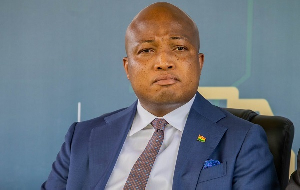
 Samuel Okudzeto Ablakwa Is the Minister for Foreign Affairs
The Ministry of Foreign Affairs has firmly denied claims that Ghana’s newly signed Security and Defence Partnership with the European Union (EU) provides for foreign military bases or the deployment of foreign troops on Ghanaian soil, stressing that the country’s sovereignty and territorial integrity remain fully intact.
In a statement dated 14 April, the Ministry clarified that the agreement is strictly a structured cooperation framework aimed at strengthening Ghana’s response to emerging security threats and enhancing both national and regional security architecture.
The partnership covers key priority areas including counter-terrorism, maritime security in the Gulf of Guinea, cybersecurity, border management, and support for peacekeeping and crisis response operations.
It also provides for technical assistance, training, and the provision of equipment to strengthen the capacity of Ghana’s security agencies in carrying out their mandate.
The Ministry stressed that the agreement is not a new or isolated initiative, but rather a continuation and formalisation of long-standing cooperation between Ghana and the European Union, which has supported various security and governance programmes across Ghana and the West African sub-region over the years.
According to the statement, the partnership consolidates existing collaboration into a more coherent and forward-looking framework designed to respond to evolving regional security challenges.
The Ministry was emphatic that at no point does the agreement provide for the establishment of foreign military bases in Ghana, nor does it permit the stationing of foreign troops on Ghanaian territory.
It reiterated that Ghana’s sovereignty and territorial integrity remain fully protected under the arrangement, adding that cooperation with the EU is based strictly on mutual respect, shared interests, and Ghana’s national security priorities.
The Ministry further noted that its attention has been drawn to misinformation and misinterpretations circulating in sections of the public space regarding the nature and implications of the partnership, describing such claims as inaccurate and not reflective of the substance or intent of the agreement.
It explained that Ghana’s decision to enter into the partnership is informed by the changing security dynamics in the West African sub-region, particularly the growing threat of violent extremism and instability in the Sahel, as well as maritime security challenges in the Gulf of Guinea.
The statement said strengthening strategic partnerships remains a key element of Ghana’s proactive approach to safeguarding peace, stability, and development in the sub-region.
It further emphasised that Ghana’s principled positions on global historical and moral issues, including its stance at the United Nations on the transatlantic slave trade, remain unchanged.
The Ministry reaffirmed Ghana’s commitment to its longstanding foreign policy of non-alignment, stating that the country will continue to engage all international partners in a constructive and mutually beneficial manner in pursuit of national interest, justice, equity, and international cooperation.
Reiterating Ghana’s foreign policy principles, the statement highlighted good neighbourliness, Pan-Africanism, and peaceful coexistence, noting that Ghana values its relations with neighbouring states and remains firmly committed to regional peace and mutual respect.
It added that Ghana will not enter into any bilateral or multilateral arrangement that undermines the security, sovereignty, or territorial integrity of its neighbours.
The Government of Ghana, the Ministry concluded, remains committed to transparency, accountability, and the protection of national sovereignty in all its international engagements.

Copyright © 1994 - 2026 GhanaWeb. All rights reserved.










