



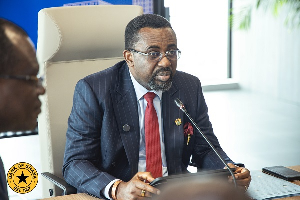
 Dr Johnson Asiama is the Governor of the Bank of Ghana
Governor of the Bank of Ghana, Dr Johnson Pandit Asiama, is calling for major changes in how the International Monetary Fund (IMF) supports its member countries, especially in Africa.
He believes the Fund needs to make “step-changes” to improve how it helps countries facing growing economic pressure.
The central bank says this review is important, especially at a time many African economies are struggling with high debt, tight global financial conditions, and long-standing structural challenges that make adjustment difficult.
Dr Asiama made these remarks while presenting a paper at the African Consultative Group Meeting attended by IMF Managing Director Kristalina Georgieva and members of the IMF Board.
He outlined two key ideas to improve how the IMF responds to countries’ needs.
He called for urgent changes to how sovereign debt issues are handled.
He said the IMF should use its influence more strongly to ensure faster debt restructuring under the Common Framework, with fair treatment and stronger involvement from private creditors.
Trade surplus surges to GH¢47.2 billion in Q4 2025
Dr Asiama also called for changes in how IMF programmes are designed, so countries are assessed more fairly.
The BoG Governor noted that; “Program design should better distinguish delays stemming from creditor coordination failures from those due to policy slippages, to ensure that strong adjustment efforts are not unduly penalised.”
He also stressed the need to improve debt sustainability tools and policies.
“In this context, we reiterate the need for a fit-for-purpose LIC DSF, the mainstreaming of the Integrated Policy Framework in program design, and a fast-tracked, more tailored implementation of the Three Pillar Approach to more effectively support members already in, or at high risk of, crisis,” he said.
On the IMF’s broader role, Dr Asiama said the Fund must be more flexible and proactive.
He suggested expanding its lending tools and making better use of its resources and also increasing concessional financing, making better use of Special Drawing Rights (SDRs), and improving how quickly support like the Resilience and Sustainability Trust can be accessed, especially for climate and liquidity challenges.
He warned that recent global events are making things worse.
“Recent shocks, including the Middle East conflict, underscore the need for well-resourced and readily accessible emergency financing to support members facing acute balance of payments pressures.”
The BoG Governor also highlighted the need for continued technical support to help countries improve revenue, manage debt, strengthen financial systems, and deal with emerging risks like cyber threats.
“Finally, sustained and targeted Fund capacity development remains essential to strengthen revenues, debt and PFM, financial oversight, and crypto cyber resilience,” he said.
He added that the ongoing Middle East tensions are putting more pressure on economies, pushing up inflation and weakening external balances.
SO/SA

Copyright © 1994 - 2026 GhanaWeb. All rights reserved.










