



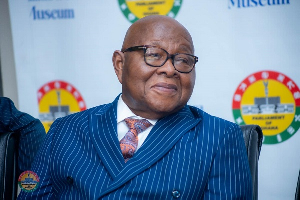
 Prof Oquaye backs High Court in stripping OSP’s prosecutorial power
Former Speaker of Parliament, Aaron Mike Oquaye, has weighed in on the growing legal controversy surrounding the Office of the Special Prosecutor (OSP), insisting that the authority of the Attorney-General cannot be overridden by any Act of Parliament.
His remarks come on the back of a recent High Court ruling which held that the OSP lacks the constitutional power to prosecute cases independently without the express approval of the Attorney-General, despite provisions in the law that established the office.
Speaking in an interview with Gemma Appiah on JoyNews, Prof. Oquaye said the decision did not come as a surprise to him, pointing to the supremacy of the 1992 Constitution of Ghana over all other laws.
“The constitutional provisions we give the Attorney-General as the sole authority to prosecute cannot co-exist with another organisation until the law of the Constitution is changed. If it's against the law, it's against the law,” Prof Oquaye stated.
Although he presided over Parliament when the OSP law was passed, he clarified that his role as Speaker was only to guide proceedings, not to influence decisions.
Beyond the legal arguments, the former Speaker expressed concern about what he sees as a growing tendency to create new institutions to address existing problems. Instead, he believes the focus should be on strengthening current structures, particularly the Office of the Attorney-General.
“All our institutions must be made stronger... The institution that is there to do a job, give it every authority, every facility, every human power, every ICT resource, and anything so that they can deliver,” he urged.
The debate centres on Article 88 of the Constitution, which names the Attorney-General as the sole authority in criminal prosecutions. While the OSP was created in 2017 to operate independently and tackle corruption without political interference, legal experts have long argued that its powers remain limited unless backed by constitutional changes.
Prof Oquaye believes the issue is far from settled and expects it to be decided by the Supreme Court of Ghana.
“This is something that must be finally resolved. I trust that it will finally go to the Supreme Court. Then we shall know for sure,” he said.
His comments add fresh momentum to the national conversation, with many now pointing to constitutional reform as the only clear path to securing full independence for the Special Prosecutor.
NA/BAI
Don't eat heavy meals after 7 pm - President Mahama advises citizens

Copyright © 1994 - 2026 GhanaWeb. All rights reserved.










