



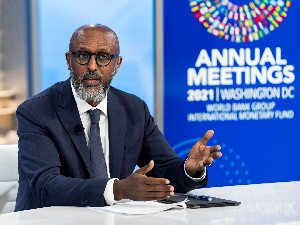
 Abebe Aemro Selassie, Director of IMF African Department
The International Monetary Fund (IMF) says Ghana’s sustainable economic future depends largely on the government, its people, and civil society, rather than external support.
While acknowledging the role of external assistance in cushioning the country, particularly during crises such as the implementation of the three-year US$3 billion loan-supported programme, the Fund stressed that sustaining gains after such interventions rests with Ghana.
Abebe Aemro Selassie, Director of the IMF’s African Department, made the remarks during the Regional Economic Outlook press briefing at the 2026 IMF/World Bank Group Spring Meetings in Washington.
When asked about Ghana’s post-Extended Credit Facility (ECF) outlook, Selassie said, “The commitments of the government under the programme have shown that, so it’s about sustaining that in the post-programme period.”
“You asked what steps the Fund has taken to ensure that. This is not for the IMF – this is for the people of Ghana – the government, private sector and civil society, and hopefully, the lessons of the recent past will be solid going forward,” he said.
Selassie expressed optimism about Ghana sustaining its recent positive economic developments, noting that authorities must ensure fiscal balance is maintained.
“There should be a continued balance between addressing development needs and avoiding debt sustainability challenges. So, it’s about sustaining that in the post-programme period,” he added.
Meanwhile, Finance Minister Dr Cassiel Ato Forson, speaking to international investors on the sidelines of the 2026 IMF/World Bank Spring Meetings, assured that government would sustain the gains.
“Government remains committed to sustaining the recovery by deepening structural reforms, maintaining fiscal discipline, and prioritising productive investments,” he said.
He explained that the gains were achieved through carefully designed policy interventions and legislative reforms. “These are not cosmetic gains; they are outcomes of well-thought-out reforms, backed by laws and disciplined implementation,” he stated.
“The gains we achieved in 2025 provide a solid platform for continued recovery and policy predictability. Our focus now is to consolidate these gains, strengthen confidence, and build a more resilient and inclusive economy.”
He added that government had intensified fiscal discipline measures, including reducing the size of government from 123 to 60 ministers and introducing mandatory commitment authorisation across Ministries, Departments and Agencies (MDAs) to strengthen expenditure controls.
He further noted that oversight institutions such as an Independent Fiscal Council and an Office of Value for Money had been established to enhance accountability and improve public spending efficiency.
In a related development, the World Bank has commended Ghana’s macroeconomic stabilisation efforts and expressed readiness to support initiatives aligned with the country’s long-term growth agenda.
Ousmane Diagana, World Bank Vice President for Western and Central Africa, said the Bank would focus on Ghana’s energy and agriculture sectors under its new Country Partnership Framework.
He stressed that macroeconomic stability remains key to unlocking investment and ensuring that reforms deliver tangible benefits to households and businesses, urging sustained commitment to reforms.

Copyright © 1994 - 2026 GhanaWeb. All rights reserved.










