



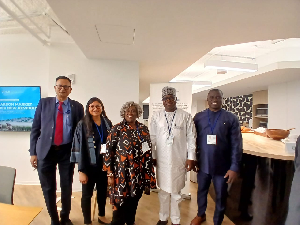
 Seidu Issifu (in white) speaks at Washington workshop on carbon markets and climate finance
Minister of State for Climate Change and Sustainability, Seidu Issifu, has called for accelerated global efforts to scale up high-integrity carbon markets as a strategic pathway to achieving both climate action and sustainable development goals.
The Minister made this call during the Carbon Finance Workshop Series: Leveraging Carbon Finance for Climate Prosperity, held in Washington, DC.
The workshop served as a critical platform for advancing dialogue on carbon finance, showcasing practical actions, facilitating knowledge exchange, and deepening understanding of key technical challenges facing carbon market implementation.
Among the prominent issues discussed were authorization processes under Article 6 of the Paris Agreement, which provides a framework for international cooperation through carbon markets and emissions trading mechanisms.
Participants explored how carbon market decision-making directly influences the achievement of Nationally Determined Contributions (NDCs) and Climate Prosperity Plans (CPPs) among member countries of the Climate Vulnerable Forum (CVF).
Discussions emphasised the importance of ensuring environmental integrity, transparency, and accountability in carbon transactions, while also maximizing development co-benefits for vulnerable economies.
The High-Level Session of the workshop focused on aligning expectations between private sector investors and buyer countries, while outlining key criteria necessary to unlock large-scale carbon finance opportunities.
It also highlighted concrete steps being taken by CVF member states to establish enabling environments that attract credible and sustainable carbon investments. These include strengthening regulatory frameworks, improving governance systems, and enhancing institutional capacity to manage carbon market activities effectively.
In the Technical Session, participants were presented with the Carbon Finance Program’s three-year strategic roadmap. The session provided a comprehensive update on global carbon market trends, as well as insights into the outcomes of ongoing Article 6 negotiations and their implications for CVF and V20 member states.
Experts further examined how a combination of international carbon markets, domestic carbon pricing mechanisms, and innovative financial instruments can be leveraged to support the implementation of NDCs, CPPs, and Long-Term Low Emission Development Strategies (LT-LEDS).
The event convened a diverse group of stakeholders, including ministers, finance ministry officials, development partners, technical experts, and representatives from international organisations.
This broad participation underscored the growing recognition of carbon finance as a critical tool for mobilising resources needed to address the climate crisis while fostering economic resilience.
During his presentation, Seidu Issufi showcased Ghana’s leadership in developing a robust national carbon project pipeline. He outlined the country’s progress toward meeting its 2030 Article 6 budget, highlighting early indicators of both climate mitigation and sustainable development impacts.
Ghana’s approach demonstrates a careful balance between environmental integrity and economic opportunity, positioning the country as a key player in the evolving global carbon market landscape.
The Minister also used the platform to share Ghana’s experience in negotiating and signing bilateral cooperation agreements under Article 6.
These agreements are designed to facilitate the international transfer of carbon credits while ensuring that such transactions contribute meaningfully to Ghana’s updated NDCs.
He emphasised Ghana’s pragmatic and transparent approach to authorizing carbon credits, which has enhanced investor confidence and provided a model for other countries seeking to operationalise Article 6 mechanisms.
Furthermore, Seidu Issifu reiterated that carbon markets must not only serve as tools for emissions reduction but also as vehicles for inclusive growth, job creation, and sustainable development.
Seidu Issifu stressed the importance of safeguarding national interests while engaging in international carbon trading, ensuring that benefits are equitably distributed and aligned with national development priorities.
The workshop concluded with a shared commitment among participants to strengthen collaboration, address technical bottlenecks, and scale up financing solutions that support climate resilience and prosperity in vulnerable countries.
Ghana’s contributions at the forum reinforced its position as a proactive advocate for high-integrity carbon markets and a leader in leveraging carbon finance to drive climate action and sustainable development.
Seidu Issifu emphasised that Ghana is leveraging Article 6 mechanisms not merely as a financing tool, but as a strategic instrument to support the implementation of its updated NDCs.
He reiterated the country’s commitment to ensuring that all carbon market activities align with national development priorities, uphold environmental integrity, and deliver measurable benefits to local communities.
The Minister concluded that, Ghana continues to demonstrate a strong commitment to innovative climate finance solutions, positioning itself at the forefront of efforts to harness carbon markets for sustainable development and climate resilience.
As global momentum around carbon markets accelerates, the outcomes of the workshop were expected to contribute to strengthening international cooperation and advancing practical solutions that enable countries, particularly the most vulnerable to climate change, to achieve their climate and development objectives.

Copyright © 1994 - 2026 GhanaWeb. All rights reserved.










