



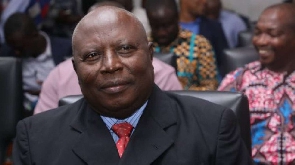
 Martin Amidu is the former Special Prosecutor
The former Special Prosecutor, Martin Amidu, has warned that the ongoing tensions between the Office of the Special Prosecutor (OSP) and the Attorney-General is harmful to the country’s fight against corruption.
In a write-up dated April 23, 2026, Amidu said the relationship between the two institutions was originally designed to be collaborative, with the Attorney General delegating prosecutorial authority to the Special Prosecutor under the law.
Deputy AG challenges OSP's jurisdictional bounds at the Supreme Court
He explained that provisions in the Office of the Special Prosecutor (Operations) Regulations, 2018 (LI 2374), particularly Regulation 11, give the Special Prosecutor the power to decide whether or not to prosecute after investigations.
“The Special Prosecutor or an authorised officer shall, upon considering the facts and evidence gathered from an investigation, take a decision whether or not to prosecute,” he stated.
Amidu argued that this delegation is consistent with Article 88 of the 1992 Constitution, and could be upheld by the Supreme Court if properly interpreted.
“I feel very strongly that when an Interested Party or Parties join the case… the Supreme Court may come to the conclusion and decide that the Special Prosecutor has prosecutorial powers under Act 959 and LI 2374,” he noted.
He also pointed to his role in shaping the operational framework of the OSP, saying the law and its regulations were developed through cooperation between his office and the then Attorney-General.
Despite this, he expressed concern over what he described as growing tensions and lack of cooperation between the current Special Prosecutor and the Attorney-General.
“The turf war and acrimony between the Special Prosecutor and the Attorney-General does not bode well for Ghana’s fight against corruption.
“The Special Prosecutor whilst maintaining some independence in making prosecutorial decisions and prosecuting must at all times remember that his authority is derived from Article 88 of the Constitution and to collaborate with the Attorney-General to achieve the objective set for the OSP in Act 959 and the pursuant Regulations upon which his functions are operationalized,” he said.
Amidu further criticised the conduct of the current Special Prosecutor, accusing him of failing to cooperate with the Attorney-General in handling case dockets and other matters.
“The Special Prosecutor refused to submit a closed docket to the Attorney-General after he had completed an investigation and decided to close the case. Upon receipt of the Attorney General’s letter requesting for the closed docket in August 2024 for residual action, the Special Prosecutor absconded abroad until there was a change of government,” he alleged.
He maintained that the challenges facing the OSP are not due to weaknesses in the law but rather the actions of individuals.
“In these circumstances, it is not Act 959 which is the problem but the Special Prosecutor who perceives himself to be above Article 88 of the Constitution,” he said.
Amidu stressed that the OSP was created to support governments in fighting corruption without fear or favour, and not as a tool for political pressure.
“... the OSP was not established as an instrument for blackmailing Governments… but an agency that will enable Governments to fight corruption without fear or favour,” he added.
Court rules OSP lacks authority to prosecute cases
He concluded that while the Special Prosecutor must exercise some independence, the office must continue to work with the Attorney-General to achieve its mandate under the law.
Amidu's comments follow a High Court's ruling stripping the OSP's prosecutorial powers.
MAG/AE
President Mahama reacts to Trump White House shooting incident

Copyright © 1994 - 2026 GhanaWeb. All rights reserved.










