



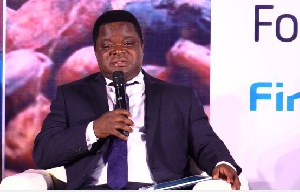
 The former Director of the ISSER, Professor Peter Quartey
The former Director of the Institute of Statistical, Social and Economic Research, Professor Peter Quartey, has praised the Bank of Ghana (BoG) for being open about its financial position, following the release of its 2025 accounts.
His comments follow the Central Bank's report of an operating loss of GH¢15.6 billion for 2025, up from GH¢9.48 billion in 2024. The latest figure extends a string of losses over the past four years, after GH¢60.9 billion in 2022 and GH¢10.5 billion in 2023.
The Bank has explained that the loss was mainly due to the high cost of its tight monetary policy measures aimed at controlling inflation.
Even though total operating income increased to GH¢22.23 billion, supported by better returns from reserve management, fee income, and proceeds from bullion gold sales, rising costs outweighed the gains.
‘Fix the issues causing gold losses’ - Joe Jackson
Speaking on The Big Issue on Channel One TV on Saturday, May 2, 2026, Professor Quartey said the Bank should be commended for making the information public.
“We need to commend past governors and current governors for disclosing this information,” he said.
He pointed out that Ghana’s largely cash-based economy continues to put pressure on the central bank, particularly in liquidity management.
“We have a systemic problem, which is that we are a cash-based economy. So anytime there’s excess liquidity, the central bank has to mop that excess liquidity,” he explained.
Professor Quartey also linked the situation to the effects of the domestic debt exchange programme, noting that it has changed investor behaviour and reduced interest in long-term government bonds.
“I remember that we had a debt exchange programme, and some coupon rates have been paid over time. So there is quite a significant amount of injection into the system because of what happened with bonds, etc. Investors are not immediately willing to lock their money into long-term bonds,” he said.
According to him, this has left the Bank of Ghana with limited options, forcing it to rely heavily on open market operations to control liquidity, which comes at a cost.
“So that was the option left for the Bank of Ghana to do open market operations and mop up the excess liquidity. And that comes with a cost,” he stated.
He stressed that the losses, though significant, are largely the result of policy decisions aimed at stabilising the economy.
“When you incur losses for a good cause, I don’t think it is a problem. What we should look at going forward is how we minimise these losses,” he added.
He further noted that Ghana stands out in terms of transparency, as some central banks in other African countries do not publicly disclose such detailed financial information.
SO/SEA

Copyright © 1994 - 2026 GhanaWeb. All rights reserved.










