



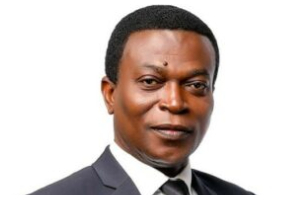
 Mark Awuah Baah has been asked to step aside as CEO of GRIDCO
The fire at the Akosombo substation, has rapidly escalated from an operational emergency into a broader governance crisis, exposing tensions among management, the board, workers, and the supervising ministry.
What began as a damaging infrastructure incident now risks becoming a defining test of institutional responsibility in Ghana’s power sector.
In the immediate aftermath of the fire, the Minister of Energy and Green Transition, John Abdulai Jinapor, announced that the Chief Executive Officer of Ghana Grid Company Limited (GRIDCo), Mark Awuah Baah, would step aside to allow for an impartial investigation. Publicly, the decision was presented as swift action intended to assure citizens that the matter would be treated with seriousness and transparency.
The move was publicly framed as a swift intervention to ensure transparency and accountability. However, subsequent developments suggest a more complicated reality.
The Minister of Government Communications, Felix Kwakye Ofosu, on April 26, 2026, announced the shake-up at GRIDCo and the Electricity Company of Ghana following recent power outages.
In a post on Facebook, Kwakye Ofosu disclosed that the energy minister had asked the GRIDCo CEO to step aside pending investigations into the fire at the Akosombo power control centre. He further noted that there had been a major shake-up in ECG’s leadership in the Ashanti Region.
He wrote: “The Minister of Energy and Green Transition has asked the CEO of GRIDCo to step aside pending investigations into the fire incident at the Akosombo power control centre.
“Also, there has been a major shake-up in the leadership of ECG in the Ashanti Region. At 2 pm tomorrow, the Minister for Energy and Green Transition, Hon. John Jinapor, will hold a major briefing on recent developments in electricity distribution.”
However, it has emerged that, two days before his purported “step aside”, and days before the fire outbreak, the CEO had already informed the board of his plans to proceed on annual leave.
Indeed, a GRIDCo circular numbered “CE/01/14/2026”, obtained by The Herald from the Office of the Chief Executive and dated 24 April 2026, shows the CEO himself announcing his departure as “annual leave” and appointing his successor.
Titled “Staff Movement”, the circular stated: “It is announced for the information of all staff that I have proceeded on my annual leave, effective Monday, 27 April 2026.”
“In my absence, Ing. Frank Otchere, Acting Deputy Chief Executive (E&O), will be responsible for the day-to-day administration of the company in addition to his normal duties. All staff are enjoined to give Ing. Otchere their maximum support and co-operation in the discharge of his additional responsibilities.”
The circular, addressed to all staff, suggests that the CEO’s absence was pre-planned rather than a direct consequence of the incident.
Additional information available to The Herald indicates that Awuah Baah has reached the mandatory retirement age and is currently serving on a one-year post-retirement contract, which is due to expire in June 2026, raising the likelihood that he may not return to the role as GRIDCo boss.
In this context, the minister’s announcement takes on a different meaning. Rather than a decisive disciplinary intervention directly linked to the incident, critics argue it may have been an optics-driven move designed to create the impression of immediate action by capitalising on an already scheduled absence.
That distinction is significant. In moments of national concern, public confidence depends not only on visible action but on credible and transparent action. When governments appear to manufacture consequences rather than pursue them, trust in the process can erode.
The situation has been further complicated by reports that some board members were dissatisfied with how the matter was handled and were not adequately consulted before the initial public communication. This points to a concerning disconnect between the ministry and the governance structures of a strategic state-owned utility.
Boards are intended to provide oversight, continuity, and institutional judgment. Bypassing them during a crisis can deepen uncertainty and blur lines of accountability.
Among sections of staff, frustration is said to run even deeper. Some workers reject the suggestion that the fire was merely an unfortunate accident, arguing instead that it reflects systemic weaknesses, including lapses in maintenance and a management culture that prioritises reaction over prevention.
According to insiders, many of the vulnerabilities exposed at Akosombo exist across other substations, where attention is often focused on responding to failures rather than preventing them. Routine maintenance and upgrades rarely attract urgency, while crises tend to command immediate resources and executive focus, a pattern described as both costly and risky.
One insider summarised the growing concern by noting that the Energy Ministry is expected to demand answers, not produce them. This observation underscores the broader governance challenge now confronting the sector.
A supervising ministry, analysts say, should insist on facts, accountability, timelines, and reform. It should not be perceived as shaping narratives, scripting outcomes, or pre-empting independent processes. Once political management begins to overshadow institutional responsibility, the credibility of any subsequent inquiry is diminished.
Further concerns have been raised about the composition of the investigative committee, chaired by William Amuna, a former GRIDCo Chief Executive and current ECG board chairman. Some staff have questioned whether such an arrangement can be considered fully independent, particularly if previous leadership periods coincided with delays in critical upgrades at the affected facility.
Even when individuals act in good faith, observers note that investigations of this scale must not only be fair but also appear to be fair. Where confidence is already fragile, perceived conflicts of interest can undermine the legitimacy of findings before the process is complete.
The Akosombo substation is a critical component of Ghana’s electricity transmission network, playing a central role in delivering power from key generation sources to the national grid. An incident of this magnitude is expected to prompt serious national reflection.
Beyond individual accountability, the episode raises broader questions about whether critical infrastructure is being managed with the foresight, technical discipline, and institutional rigour required.
Analysts warn that if the conditions that led to the Akosombo fire are replicated elsewhere, the greater risk may lie ahead. They argue that what is now required is a genuinely independent investigation, publication of findings, clear attribution of responsibility where negligence is established, and a comprehensive audit of substations and control facilities nationwide.
Delayed maintenance, weak governance, and reactive management, they caution, are risks that accumulate quietly until failure makes them visible.
Ultimately, the Akosombo fire has highlighted a familiar but concerning pattern in public infrastructure management: weak prevention, delayed decision-making, and public relations substituting for substantive accountability.
Whether this incident becomes another unresolved crisis or a turning point for reform may depend on how authorities respond in the weeks ahead.
Health Focus: Sucking breast isn’t therapy for men - Doctor

Copyright © 1994 - 2026 GhanaWeb. All rights reserved.










