



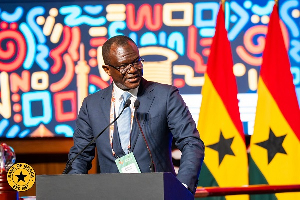
 Dr Zakari Mumuni, First Deputy Governor of the Bank of Ghana
The First Deputy Governor of the Bank of Ghana, Dr Zakari Mumuni, has called for urgent action to build inclusive instant payment systems as a foundation for Africa’s digital economy, stressing that fragmented payment structures continue to limit economic integration across the continent.
Delivering a keynote address at the 3i Africa Summit 2026 in Accra on May 6, 2026, Dr Mumuni said Africa has made significant progress in expanding financial access, but the underlying payment infrastructure remains costly, siloed, and insufficiently interconnected.
“Africa stands at a decisive moment. We have achieved remarkable progress in expanding access to financial services, yet the foundations of our payment systems remain fragmented, costly, and insufficiently interconnected,” he said.
Ghana, US sign bilateral debt deal to restructure EXIM Bank obligations
He stressed that inclusive instant payments are no longer optional but a critical form of economic infrastructure needed to support growth and integration.
“Until we resolve this, the promise of a fully integrated digital economy will remain unrealised. Inclusive instant payments are therefore not optional, they are essential infrastructure,” he stated.
Dr Mumuni noted that while mobile money, fintech platforms, and digital wallets have improved access to financial services, gaps in interoperability and high transaction costs continue to hinder efficiency.
“Access without seamless usability has limits. High transaction costs, siloed platforms, and constrained interoperability continue to impede the efficient flow of value across systems, sectors, and borders,” he said.
He argued that Inclusive Instant Payment Systems (IPS), if properly designed, could transform fragmented financial access into a unified ecosystem that enables real-time, low-cost transactions.
“Inclusive Instant Payment Systems provide a clear path forward. If properly designed and implemented, they enable real-time, low-cost transactions across interoperable networks,” he explained.
Dr Mumuni also highlighted the economic benefits of instant payment systems, including improved liquidity for businesses, enhanced financial inclusion for households, and stronger revenue mobilisation for governments.
“Instant payments accelerate business cash cycles, strengthen liquidity management, and enhance productivity,” he said.
However, he warned that progress across Africa remains uneven, noting that no instant payment system has yet achieved full inclusivity at scale.
“This underscores a central reality: building infrastructure is not enough—we must ensure that it works universally and equitably,” he said.
He called for stronger coordination among regulators, financial institutions, and fintech operators to deepen interoperability and reduce friction in payment systems.
Dr Mumuni also urged reforms in eKYC frameworks, licensing regimes, and cross-border cooperation to strengthen integration across jurisdictions.
In Ghana, he said progress has been made in deploying instant payment platforms and improving interoperability, but more work remains to ensure accessibility and trust.
“The objective is not simply to build systems, but to ensure that they are accessible, affordable, and trusted by every segment of society,” he noted.
He concluded by calling for collective commitment to accelerate the development of inclusive instant payment systems across Africa.
MA

Copyright © 1994 - 2026 GhanaWeb. All rights reserved.










