



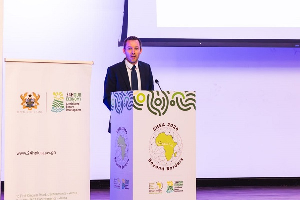
 Vice President and Head of AAK West Africa, Lasse Skaksen
AAK, a global producer of plant-based oils and fats with a long-standing presence in West Africa’s shea sector, has called for stronger regional coordination and resilience across the shea value chain to unlock the industry’s full economic potential.
The call was made during the 18th Annual Conference of the Global Shea Alliance, held in Accra under the theme “Beyond Borders”, which brought together policymakers, diplomats, industry leaders, financiers, and development partners from across West Africa and beyond.
The conference was attended by Vice President Jane Naana Opoku-Agyemang, who highlighted structural inequalities in the sector and called for reforms to ensure women benefit more equitably from the value they create.
“Women dominate the shea value chain from nut collection to primary processing, while supporting families and communities across the country. Women need to benefit more from the value they create. Addressing this imbalance is not only a matter of equity, but essential for improving productivity and ensuring the sector’s long-term sustainability,” she said.
Participants at the conference stressed the importance of strengthening intra-African trade under the African Continental Free Trade Area (AfCFTA) to improve competitiveness, scale processing, and retain more value within the region.
AAK contributed to discussions on global market trends, supply chain traceability, and the future outlook of the shea industry within the global oils and fats market. The company emphasised the need for reliability, quality consistency, and sustainability to meet evolving international market demands.
Vice President and Head of AAK West Africa, Lasse Skaksen, said the sector’s growth depends on collaboration between stakeholders and a stable investment environment.
“Driving the transformation of shea remains a shared responsibility. Private sector must continue to invest; governments must continue to create a stable, predictable and enabling environment for investors,” he said.
He added: “Together, we must advance a shared agenda that benefits every stakeholder: strengthening long-term trust in shea and reinforcing its competitiveness as a global ingredient, especially amid growing pressure from shea alternatives.”
AAK also highlighted the need to strengthen the base of the value chain through investment in women collectors, improved logistics, and access to finance. Through its Kolo Nafaso programme, the company says it works directly with over 275,000 women across West Africa to support capacity building, responsible sourcing, and market access.
The conference ended with a renewed call for collaboration between governments, private sector actors, and development partners to accelerate investment, improve policy alignment, and position West Africa as a global hub for value-added shea production.
AAK said its participation reflects its commitment to transforming the shea sector from a raw commodity-based industry into a more integrated, value-driven, and sustainable engine of regional economic growth.

Copyright © 1994 - 2026 GhanaWeb. All rights reserved.










