



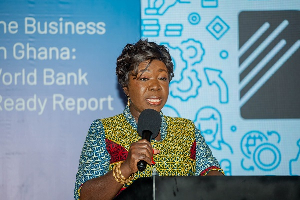
 Elizabeth Ofosu-Adjare is the Minister for Trade, Agribusiness and Industry
The Minister of Trade, Agribusiness and Industry, Elizabeth Ofosu-Adjare, stated that Ghana’s economic future relies on unlocking the full potential of women entrepreneurs and professionals.
Speaking at the 2026 Ghana Female CEOs Summit held at the Kempinski Hotel on Thursday, May 7, she emphasized that women are central to Ghana’s competitiveness and resilience.
According to myjoyonline.com, she highlighted how women have consistently proven their value in business despite facing structural challenges.
“You have built businesses, created employment, navigated economic headwinds, and refused to be footnotes in Ghana’s growth story,” she remarked.
The minister pointed out that women make up 51% of Ghana’s population but remain underutilised.
They own 40% of businesses and account for over 70% of workers in the food system, yet they still struggle with limited access to financing and agribusiness assets.
She cited estimates from the International Finance Corporation (IFC) indicating that closing the gender financing gap for small and medium-sized enterprises (SMEs) in Sub-Saharan Africa could generate $42 billion annually.
Additionally, McKinsey projects that advancing women’s equality could contribute $316 billion to Africa’s GDP.
“These are not just soft statistics; they are economic imperatives,” she stressed.
Ofosu-Adjare highlighted the Ghana Women’s Development Bank, which is supported by GH¢401 million in the 2026 budget.
This bank will provide low-interest credit, flexible collateral, mentorship, and business support to women entrepreneurs.
She also discussed the 24-Hour Economy Authority Act of 2026, which will create opportunities for women in manufacturing, agro-processing, retail, and hospitality through tax incentives, reduced electricity costs, and financing from EXIM Bank.
“For women entrepreneurs, this is transformational,” she stated.
Furthermore, she mentioned the Affirmative Action Law of 2024, launched in July 2025, which mandates increased female representation in decision-making roles across both public and private sectors.
The minister noted that the African Continental Free Trade Area presents significant opportunities for women in areas such as cassava processing, textiles, pharmaceuticals, and palm oil.
The government aims to raise non-traditional export earnings from $3.5 billion to $10 billion by 2030.
The Ministry is also rolling out initiatives to enhance export readiness, mentorship programs, and industrial park incentives for women-owned businesses, including land rebates in the next three zone enclaves.
“We see you. We are building for you,” she said, quoting President Mahama: “When women succeed, families thrive, and nations prosper.”
NAD/AM
GhanaWeb partners Boris Kodjoe's FCST in exclusive travel platform deal

Copyright © 1994 - 2026 GhanaWeb. All rights reserved.










