



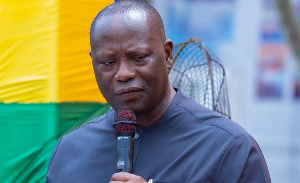
 Emmanuel Armah-Kofi Buah is the Minister of Lands and Natural Resources
Blue Gold Limited has announced what it describes as a significant procedural victory in its ongoing arbitration proceedings against the Government of Ghana in the US$1 billion dispute over the Bogoso-Prestea Mine in the Western Region.
The legal storm was sparked when the Akufo-Addo administration handed the concession to Heath Goldfields Ghana Limited, owned by ex-Finance Minister Dr Kwabena Duffuor. The Mahama government refused to act on the matter despite repeated attempts by the British company to engage it for a review of the decision.
The arbitration, administered by the Permanent Court of Arbitration in The Hague under PCA Case No. 2025-21, involves Blue Gold and Future Global Resources Limited pursuing claims against the Republic of Ghana under the bilateral investment treaty signed by Ghana and the United Kingdom in 1989.
The Office of the Attorney-General and Ministry of Justice has engaged Gateley Legal and Atuguba and Associates to assist Ghana’s legal team in defending the US$1 billion damages claim.
On Wednesday, May 6, 2026, the company said that the arbitration formally commenced on April 2, 2025, pursuant to the Agreement between the Government of the United Kingdom of Great Britain and Northern Ireland and the Government of the Republic of Ghana for the Promotion and Protection of Investments.
Blue Gold disclosed that on February 27, 2026, Ghana requested that the arbitral tribunal divide the proceedings into three stages, a process known in arbitration as “trifurcation”.
Under Ghana’s proposal, the tribunal would first determine jurisdictional questions, then, if necessary, proceed to issues relating to liability and, subsequently, damages.
However, on April 10, 2026, the tribunal issued Procedural Order No. 3 rejecting Ghana’s application.
The tribunal stated that it was “not persuaded that bifurcation or trifurcation is appropriate at this stage”, citing the overlap between Ghana’s objections and the substantive factual issues underlying the dispute, as well as the potential duplication of time, cost and effort.
Reacting to the ruling, Andrew Cavaghan, Chief Executive Officer of Blue Gold, welcomed the decision, saying it would allow the company’s claims to proceed more efficiently on a consolidated basis.
“We welcome the Tribunal’s decision, which ensures the merits of the Company’s Treaty claims will now be decided by the international tribunal on a single, consolidated track much more quickly and efficiently than it would otherwise have been,” Cavaghan stated.
He added that the company remained committed to pursuing its claims “in a disciplined and constructive manner” while remaining open to an amicable resolution with the Government of Ghana.
Blue Gold, which is represented in the arbitration by Mayer Brown, said it would now proceed with preparations for its Memorial on the Merits, the next substantive filing in the proceedings.
The company, listed on the NASDAQ under the ticker symbol BGL, describes itself as a next-generation gold exploration, development and mining company focused on acquiring and developing mining assets across strategic global jurisdictions.
Blue Gold says it intends to combine traditional mining operations with innovative financial models, including asset-backed digital instruments, while maintaining commitments to responsible mining, sustainability and operational transparency.
The arbitration adds to a growing number of international investment disputes involving Ghana’s mining sector in recent years, as foreign investors increasingly turn to international tribunals to resolve disputes arising from mining concessions, licences and regulatory interventions.
The Government of Ghana has not yet publicly commented on the tribunal’s latest procedural ruling.
A statement from The Hague, dated 6 MAY 2026, titled “Developments Since Commencement of Proceedings”, provided a chronology of events.
First Procedural Meeting, Procedural Order No.1 and Terms of Appointment
On February 19, 2026, the Tribunal in an arbitration commenced by Blue Gold Holdings Limited (United Kingdom) and Future Global Resources Limited (United Kingdom) against the Republic of Ghana held a First Procedural Meeting. The meeting was held by video-conference.
During the meeting, the Tribunal consulted the Parties in respect of the procedural framework for the arbitration, including the calendar for written submissions and hearings.
Counsel and representatives for the Claimants and Respondent were present at the meeting. On March 16, 2026, the Tribunal issued Procedural Order No. 1, which included a Procedural Calendar. On March 16, 2026, the Tribunal and the Parties concluded the Terms of Appointment.
Claimants’ Request for Temporary Restraining Order
On March 4, 2026, the Claimants filed a request for an urgent temporary restraining order, seeking an immediate order temporarily restraining the Respondent from commencing any arbitration under the Bogoso Prestea Mining Leases until the Tribunal’s determination of a full application for interim measures. The Claimants also requested leave to file a full application for interim measures by March 24, 2026.
The Respondent filed its response opposing the Claimants’ requests on March 6, 2026.
Procedural Order No. 2
On March 19, 2026, the Tribunal issued Procedural Order No. 2 in which it denied the Claimants’ request for a temporary restraining order reasoning that the application does not satisfy the requirements of Article 26(3) of the 2021 UNCITRAL Rules.
In Procedural Order No. 2, the Tribunal also denied the Claimants’ request to file a full application for interim measures by 24 March 2026. The Tribunal reasoned that “such a step would have been justified only in conjunction with the grant of a temporary restraining order.”
Respondent’s Request for Trifurcation
On February 27, 2026, the Respondent requested the Tribunal to separate the proceedings into up to three distinct phases addressing, respectively: (i) jurisdiction and admissibility objections; (ii) liability (if necessary); and (iii) quantum (if necessary).
The Claimants filed their response opposing the Respondent’s application on 13 March 2026.
Procedural Order No. 3 – Decision on Trifurcation
On April 10, 2026, the Tribunal issued Procedural Order No. 3 on the Respondent’s request for trifurcation of the proceedings.
The Tribunal denied the Respondent’s request, reasoning, inter alia, as follows: [T]he Tribunal is not persuaded that bifurcation or trifurcation is appropriate at this stage. On the present record, it is not possible to clearly delineate the proposed phases in a manner that would avoid duplication of time, cost, and effort. In particular, the degree of overlap between the Objections and the factual matrix underlying the merits remains insufficiently clear.
A more informed assessment may be possible at a later stage of the proceedings, with the benefit of a better developed record, should the need arise.
Background of the Arbitration
The arbitral proceedings were instituted on April 2, 2025, when the Blue Gold Holdings Limited (United Kingdom) and Future Global Resources Limited (United Kingdom) served on the Republic of Ghana a Notice of Arbitration pursuant to Article 10 of the Agreement between the Government of the United Kingdom of Great Britain and Northern Ireland and the Government of the Republic of Ghana for the Promotion and Protection of Investments, signed on 22 March 1989.
The three-member Tribunal is composed of by Professor Dr. Klaus Michael Sachs as Presiding Arbitrator (a national of Germany), Dr. Raëd Fathallah (a national of Lebanon, Canada and France), who was appointed by the Claimants, and Professor Dr. Mohamed S. Abdel Wahab (a national of Egypt), who was appointed by the Respondent.
Pursuant to an agreement of the Parties, the Permanent Court of Arbitration (“PCA”) serves as the registry in this arbitration.
Background on the Permanent Court of Arbitration
The Permanent Court of Arbitration is an intergovernmental organization established by the 1899 Hague.
Convention on the Pacific Settlement of International Disputes. The PCA has 128 Contracting Parties.
Headquartered at the Peace Palace in The Hague, the Netherlands, the PCA facilitates arbitration, conciliation, fact-finding, and other dispute resolution proceedings among various combinations of States, State entities, intergovernmental organizations, and private parties.
The PCA’s International Bureau is currently administering eight inter-state arbitrations, one other inter-state proceeding, 86 arbitrations arising under bilateral or multilateral investment treaties or national investment law, 96 arbitrations arising under contracts involving a State or other public entity, and eight other proceedings.

Copyright © 1994 - 2026 GhanaWeb. All rights reserved.










