



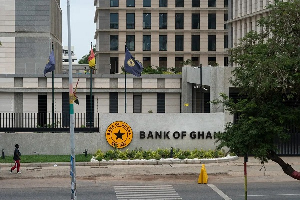
 Bank of Ghana's headquarters
The Bank of Ghana released its Financial Statements for the period January 1 to 31 December 2025 on May 1, 2026, in accordance with the law.
On page 15, the Consolidated and Separate Statements of Profit or Loss for the year ended 31 December 2025 clearly reported an operating loss of GH¢15.6 billion, with the note that “the notes on pages 24 to 132 form an integral part of these financial statements.”
On page 16, the Consolidated and Separate Statements of Other Comprehensive Income also disclosed the Other Comprehensive Income (OCI) figure as well as the Total Comprehensive Income figure for the year ended 31 December 2025.
Additionally, in an official Questions and Answers document issued by the Bank on its financial statements, the very first question references both the operating loss and the OCI loss.
Seth Terkper defends gold sector reforms
Under International Financial Reporting Standards (IFRS), a “loss” extends beyond day-to-day operations. It includes comprehensive income, which captures exchange rate movements, bond revaluations, and broader economic shocks.
In simple terms, operating performance reflects how the Bank managed its core activities, while comprehensive income reflects the wider impact of economic conditions on its balance sheet.
Not all losses are the same, as the report indicated that some stem from operational performance, while others are driven by external economic conditions.
Although part of the loss was operational, a significant portion was non-cash and resulted from the cedi appreciating by more than 40 percent during the review year, according to the full report.
Verdict: The claim that the Bank of Ghana reported a lower loss figure to hide losses is FALSE.
'We must shape the environment for innovation to thrive' - Deputy BoG Governor

Copyright © 1994 - 2026 GhanaWeb. All rights reserved.










