



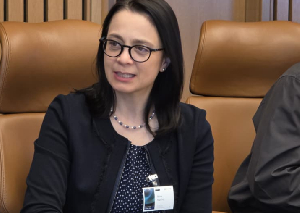
 Nina Marini, Director at Microsoft headquarters in Redmond
A director at Microsoft headquarters in Redmond, Washington State, and co-founder of Ashesi University, Nina Marini, has praised Ghana’s proposed One Million Coders initiative, describing it as a timely intervention to prepare young people for the digital future.
According to her, Ghana’s youthful population has the potential to compete globally if given the right technological training and support.
Marini made the remarks during a brainstorming session with Ghana’s Ambassador to the United States, Victor Emmanuel Smith, and his team at Microsoft Headquarters in Redmond, Washington.
Reflecting on the vision behind Ashesi University, Marini said the institution was founded to nurture ethical, entrepreneurial and solution-driven leaders capable of transforming Ghana and the African continent.
“The premise of the university was to train a new generation of leaders who are entrepreneurial, who are ethical, to help lead Ghana and the continent,” she said.
She explained that Ashesi’s educational philosophy goes beyond preparing students for employment, focusing instead on critical thinking, collaboration, communication and continuous learning.
“It was never just about teaching a set of material for people to go and find jobs. It was about learning how to think critically, collaborate, communicate effectively, and always keep learning,” she stressed.
Marini also highlighted the growing relevance of artificial intelligence and emerging technologies, describing the current era as a unique opportunity for Ghana to position itself at the forefront of digital innovation.
She further suggested that Ghana’s One Million Coders initiative could be strategically aligned with Microsoft’s digital ecosystem and training platforms.
“By combining initiatives like One Million Coders, Microsoft Learn and Microsoft Startups, we can build an economy of innovation and engineering to develop the next generation of innovators,” she stated.
Ambassador Victor Emmanuel Smith, on his part, reaffirmed the Ghanaian government’s commitment to youth empowerment, artificial intelligence skills development, cybersecurity and building a strong digital economy.
Meanwhile, a Microsoft Security investigator, Peter Anaman, underscored the need to equip young people with the skills to responsibly utilise artificial intelligence while addressing growing cybersecurity threats.
He noted that the increasing sophistication of cybercrime globally requires a balanced approach that combines innovation with digital safety.
“We need to work on how we empower our youth to use AI to develop new solutions,” he said.
Anaman added that tools such as Microsoft Copilot and other AI platforms can help young innovators solve problems and accelerate development when used strategically and responsibly.
He also called for stronger collaboration between governments and technology companies to support innovation and digital transformation.

Copyright © 1994 - 2026 GhanaWeb. All rights reserved.










