



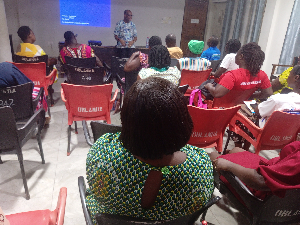
 The workshop brought together several stakeholders
Correspondence from the Eastern Region
Efforts to reduce the growing HIV prevalence in the Lower Manya Krobo Municipality in the Eastern Region must begin with tackling the high rate of patients defaulting on Anti-Retroviral Therapy (ART), health professionals and stakeholders have said.
According to officials involved in the Youth and Women Empowerment (YOWE) HIV intervention project, many Persons Living With HIV/AIDS (PLHIV) in the municipality stop taking their medication or fail to report to health facilities for treatment, increasing the risk of further transmission within communities.
The concerns were raised during a review workshop organised by the Youth and Women Empowerment (YOWE) organisation at the Lower Manya Krobo Municipal Assembly Mini Conference Hall on May 7, 2026, under the theme: “Reducing the Impact of HIV and AIDS Through Volunteerism in the Lower Manya Krobo Municipality.”
The workshop brought together officials from the Municipal Health Directorate, Atua Government Hospital, St Martin De Porres Hospital, community volunteers, media practitioners, and representatives of the Lower Manya Krobo Municipal Assembly.
The project, funded by the STAR Ghana Foundation, seeks to reduce ART default rates and reconnect patients to treatment through a volunteer-based community intervention.
Lower Manya Krobo remains one of the areas with the highest HIV prevalence rates in Ghana.
2024 HIV data showed that the municipality recorded the country’s highest HIV prevalence rate of 4.65 percent, with 194 new infections reported within the year.
Executive Director of YOWE, Emmanuel Nuetey Siakwa, said the municipality had previously recorded an ART defaulter rate of about 35 percent, but the intervention had helped reduce the figure to approximately 23 percent during the first phase of implementation.
He explained that reducing treatment defaulting was critical to lowering HIV prevalence because patients who consistently take their medication are less likely to transmit the virus.
“If people continue taking their medication, the viral load suppresses, and transmission reduces. But when people stop treatment, it contributes to the high prevalence we are seeing in the municipality,” he said.
Siakwa disclosed that through the project’s “Models of Hope Volunteers,” over 100 patients had been re-enrolled onto treatment within two months.
Data presented at the workshop showed that volunteers in the first quarter of 2026, reached 499 people, comprising 159 males and 340 females. Out of that number, 212 patients — 74 males and 138 females — were successfully enrolled or reconnected to treatment.
Physician Assistant and HIV Coordinator at the Atua Government Hospital, Naomi Badzi, said reducing default rates could significantly lower HIV transmission in the municipality.
She explained that the HIV treatment strategy known as “Undetectable Equals Untransmittable” (U=U) means patients who consistently take their medication suppress the virus to levels that greatly reduce the chances of infecting others.
“Once clients take their medications consistently, their viral load reduces or becomes suppressed. When the virus is suppressed, the chances of transmission are also reduced,” she explained.
Badzi said stigma, fear of exposure, transportation difficulties, and poverty continued to discourage many patients from visiting health facilities for treatment.
She noted that community-based medicine delivery through volunteers was helping address some of those barriers.
“We need a multi-sectoral approach. The health sector alone cannot fight this problem. Communities, NGOs, health institutions and patients themselves all have roles to play,” she added.
Physician Assistant at St. Martin’s Hospital, Agormanya, Joseph Kweku Tetteh, described the growing number of newly diagnosed patients who default on treatment as alarming.
He said many patients diagnosed during hospital admission fail to return for follow-up care despite counselling efforts.
According to him, the volunteer tracing programme has however helped bring several old defaulters back onto treatment.
“We are seeing improvements because the volunteers are tracing and calling patients who stopped treatment. Many of them are now returning for their medication,” he stated.
Stakeholders at the workshop also identified denial of HIV-positive status, stigma, lack of cooperation from some prayer camp operators, and financial hardship as major challenges affecting treatment adherence.
The YOWE project aims to equip and support 11 community volunteers to help reduce the ART defaulter rate from 35 percent to at least 25 percent across 10 communities in the municipality.
Participants also discussed how local health institutions and the Municipal Assembly could sustain the intervention after funding support from the STAR Ghana Foundation ends.

Copyright © 1994 - 2026 GhanaWeb. All rights reserved.










