



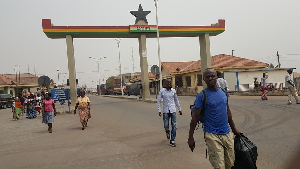
 The woman said they were taken to Aflao border and forced to cross to Togo
Ghana has come under international attention following claims that some West African migrants deported from the United States to Accra were later allegedly forced across the border into Togo despite court protections against their return.
According to a report by The Washington Post, at least 34 West Africans have been deported to Ghana since September 2025 under a third-country deportation agreement between the US and Ghana.
Watch video of deported 'Kubala King' in Sunyani
The report focused on a 28-year-old Togolese woman who said she fled her country to escape female genital mutilation (FGM) but was eventually deported by US authorities to Ghana before being sent back into Togo.
The woman explained that she became frightened after discovering that a US military cargo plane carrying her and 13 other West Africans was heading to Ghana, a country she had no ties to.
According to the report, the woman whose identity has been withheld said after spending nearly two weeks in detention near Accra, armed guards transported her and six other migrants to the Aflao border and instructed them to cross into Togo on foot.
They were allegedly separated into two groups of three, given less than $150 each, and ordered to cross the border into Togo on foot, the deportees said in the lawsuit filed in Ghanaian courts.
Of the six people sent to Togo, only two were from there, the woman said. They walked for miles before boarding a taxi to Lomé, Togo’s capital city along the Atlantic coastline, the woman said.
The woman added that she parted ways with the group at a hotel and called her mother.
“I traveled from here to the US to save my life. I had a chance … but all these foolish people took my dreams," she said.
“I know God is with me, but I’m tired. I’m a human being. I have to live, like everybody,” she added in an emotional interview with The Washington Post.
The woman stated that she has since gone into hiding in Togo over fears that she could face female genital mutilation, which she had escaped from in 2024.
She alleged that her cousin died after undergoing the practice earlier that year.
“The whole family hid the reason for her death except for my mother and her brother, who told me the truth,” she said in her asylum declaration.
“Fear once again became a part of my daily life, knowing that I was bound to be the next to be cut under the circumciser’s sharp knife,” she stated.
The report said a US immigration judge had granted her protection against deportation to Togo under international anti-torture laws.
However, she was later transferred from Arizona to Louisiana and flown to Ghana.
“Unfortunately for me, one day they just transferred me from Arizona to Louisiana and then from Louisiana to Ghana,” she said.
The Washington Post reported that at least 11 of the 14 migrants on that flight had judicial protections against deportation to their home countries.
Another deportee from Gambia also claimed he was deported to Ghana before eventually being sent back to Gambia, where he said he is currently in hiding.
The deportees have reportedly filed lawsuits in both the United States and Ghana challenging the deportation arrangement.
The migrants also described poor detention conditions in Ghana, alleging they had limited access to running water, medical care, bedding, and hygiene products while being held near Accra.
Ghana’s government has previously defended the arrangement with the United States.
President John Dramani Mahama said Ghana agreed to accept some deportees from the US because of regional free movement arrangements within West Africa.
Ghanaian women in Saudi detention to be deported home soon – Ambassador Sinare
“We were approached by the U.S. to accept third-party nationals who were being removed from the U.S., and we agreed with them that West African nationals were acceptable,” Mahama was quoted to have said.
The Office of the President and Ghana’s Foreign Affairs Ministry reportedly did not respond to requests for further comment from The Washington Post on the terms of the deportation agreement.
MAG/VPO
Stakeholders mark May 9 Anniversary with strong anti-violence message

Copyright © 1994 - 2026 GhanaWeb. All rights reserved.










