



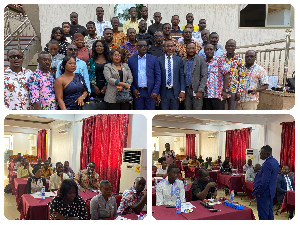
 Collaged photos of the journalists and the officials during the sensitisation program
A collaborative initiative between the Ghana Investment Promotion Centre (GIPC) and Transparency International Ghana has successfully trained approximately 40 journalists to enhance their understanding and reporting of the country’s investment framework.
The training programme was launched following research findings that revealed a significant knowledge gap among the Ghanaian public regarding how the government attracts and manages investments.
Benedict Doh, Head of Finance at Transparency International and lead coordinator of the programme, said the initiative aims to equip media professionals with the technical expertise needed to produce accurate, transparent, and accountable stories that contribute to national development.
He emphasised that transparency and accountability are key pillars of the investment packages Ghana seeks to attract.
“Our research indicated a low level of public understanding of the mechanisms government uses to attract investment into the country. One of our key project activities is to train journalists so they can have a thorough grasp of Ghana’s investment regime and produce well-informed stories,” he said.
Meanwhile, the training session provided a deep dive into the practical workings of the investment sector. Officials from the GIPC guided journalists through the mandatory requirements for business registration and the capital requirements for foreign investors seeking to enter the Ghanaian market.
A significant portion of the workshop was dedicated to the GIPC Act, where participants were taken through the legal framework governing investments. Journalists examined various provisions within the Act, many of which sparked discussions on how the law protects both the state and investors.
Highlighting the importance of understanding the GIPC Act, he noted that it clearly defines the operational boundaries for foreign investors, explicitly barring them from sectors such as retail, petty trading, and hairdressing salons.
He added that the sensitisation programme was designed to equip journalists with knowledge of the legal and technical aspects of foreign direct investment (FDI) and local participation. This, he said, would enable journalists to identify and report violations effectively. According to him, reporting such infractions to the GIPC would help authorities enforce compliance with national investment laws and strengthen the economy.
“The interesting aspect was seeing participants engage directly with the GIPC Act. They were able to identify provisions that are vital to our economic landscape,” the coordinator added.
The Deputy Director and Ashanti Regional Head of the Ghana Investment Promotion Centre, Michael Otchere, stated that while the institution will not hesitate to clamp down on unregistered and illegal business operations, its immediate priority is to educate business owners on the right procedures.
He emphasised that the primary goal of the institution is to support businesses to operate legally, which is why it adopts a friendly and informative approach when dealing with unregistered enterprises.
“Our advice is that when we find that you are not registered or are operating illegally, we will educate you first. That is the first step,” he explained.
He noted that many small business owners operate illegally due to a lack of information, which the institution is working to address.
However, he warned that those who refuse to comply after being educated will face strict legal consequences, including possible prosecution.
“We will definitely ensure that the relevant authorities with prosecutorial powers are informed. After educating you, we will then hand you over to the necessary authorities,” he said.
He urged entrepreneurs in the Ashanti Region to take advantage of sensitisation campaigns, formalise their operations, and avoid legal issues associated with unregistered businesses.
He also called on the media to collaborate with the GIPC and other stakeholders to raise awareness of the GIPC Act, ensuring that foreign business operations in Ghana are properly regulated and that the business environment is protected.
Under current laws, he explained, every foreign investor is required to register with the Office of the Registrar of Companies (ORC) and subsequently obtain a certificate from the GIPC. However, he expressed concern that many investors fail to complete the GIPC registration after visiting the ORC, allowing some businesses to operate outside regulatory oversight and affecting government revenue.
He further raised concerns about the illegal practice of “fronting,” where foreigners use Ghanaian citizens to register businesses in order to circumvent legal requirements. He warned that while a company may appear Ghanaian on paper, any foreigner found to be the actual operator in violation of the law will be treated as an offender and may be handed over to law enforcement agencies.
Following a radio sensitisation tour that began last year, the GIPC has pledged to intensify efforts to ensure strict enforcement of laws governing foreign traders.

Copyright © 1994 - 2026 GhanaWeb. All rights reserved.










