



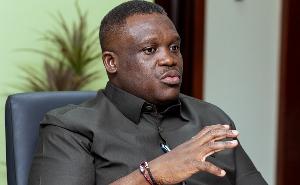
 Member of Parliament for Ningo-Prampram, Sam George
The Member of Parliament for Ningo-Prampram, Sam George, has rejected claims that recent amendments to Ghana’s proposed Anti-LGBTQ+ legislation have weakened the bill, insisting the changes are intended to provide clarity and strengthen its constitutional standing.
Speaking on Joy News’ Newsfile on May 30, 2026, the lead sponsor of the Human Sexual Rights and Family Values Bill explained that the newly introduced exemptions were designed to clearly define circumstances that should not be considered advocacy or promotion of LGBTQ+ activities under the law.
He argued that the original bill already subjected its provisions to the Constitution, but concerns raised by stakeholders, including lawyers, medical practitioners, journalists, and international organisations, necessitated clearer wording.
According to him, the amendments protect constitutionally guaranteed rights such as legal representation, academic freedom, medical care, privileged communications, and legitimate journalistic work.
“We say we have a principle. Let’s stick to that principle. There are things we play politics with, and there are things we don’t play politics with,” Sam George stated.
He accused some members of the opposition New Patriotic Party (NPP) of politicising the debate over the bill.
“It hurts me to say that Ntim Fordjour and a number of the NPP people who are speaking on this matter are simply playing politics. It’s about trying to whitewash President Akufo-Addo’s refusal to sign the bill,” he said.
George maintained that the exemptions do not create loopholes but rather establish clear legal boundaries for courts and law enforcement agencies once the bill becomes law.
On concerns regarding legal and medical services, he argued that constitutional rights cannot be overridden by the legislation.
“The constitutional rights to legal representation cannot be overridden by this Act. So state it clearly that the provision of legal services or legal representation is not considered advocacy,” he explained.
The MP also defended exemptions for journalists and media organisations, saying ordinary news reporting should never be criminalised.
“I had always maintained that a journalist doing his journalistic work was not going to be liable for advocacy,” he said.
Parliament-passes-anti-LGBTQ-bill-again-2036855”>Ghana's Parliament passes anti-LGBTQ bill again
Addressing criticism that the amendments amount to an admission that the original bill lacked clarity, George disagreed, insisting the previous draft was not flawed.
“I haven’t said the previous one was bad. But if we’ve decided to spell out what those exemptions are, we have reiterated the fact that the law does not make you liable for offering legal services, medical services, or reporting as a journalist,” he noted.
He also renewed criticism of former President Nana Akufo-Addo for failing to assent to the bill before leaving office, despite the Supreme Court dismissing legal challenges against it.
“President Akufo-Addo was still president for almost three weeks after the Supreme Court decision. He could have signed the bill. He chose not to, for reasons best known to him,” George asserted.
In 18minutes, @samgeorgegh explains most of the big conversations surrounding the Anti-LGBTQ bill, and all matters arising. #Newsfile pic.twitter.com/8ddLkjY1Kf
— Joy 99.7 FM (@Joy997FM) May 30, 2026

Copyright © 1994 - 2026 GhanaWeb. All rights reserved.










