



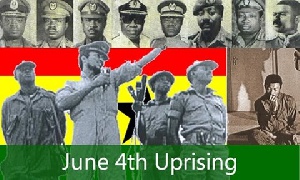
 Collage of fallen soldiers on June 4, 1979
Today marks the 47th anniversary of the June 4 Revolution; otherwise known as the June 4 Uprising, a pivotal and highly polarising flashpoint in Ghana’s political history.
What began as an internal military mutiny quickly transformed into a national upheaval that reshaped the trajectory of the Fourth Republic.
The Genesis of the Mutiny
The roots of the uprising trace back to May 15, 1979, when Flight Lieutenant Jerry John Rawlings, alongside a group of junior military officers, launched a failed coup against the ruling Supreme Military Council II (SMC II).
The mutiny was swiftly quelled following an exchange of fire between the plotters and government loyalists.
It took the intervention of a senior military officer, Major-General Odartey Willington, to secure the Ghana Broadcasting Corporation (GBC) and announce that the coup had been foiled.
For their roles in suppressing the mutiny, Major-General Willington and Major Sulemana were rewarded by the SMC II, while Rawlings and his men were arrested.
Rawlings cited severe grievances for the May 15 attempt. Junior officers were consistently denied salaries, and the nation was reeling from widespread corruption among SMC officials, poor governance, economic hardship, and rampant indiscipline within the rank and file of the Ghana Army.
Today in History: Rawlings commemorates 39th June 4 uprising
The Road to June 4, 1979
On May 15, 1979 Rawlings leads a failed mutiny against SMC II. Plotters were arrested and detained after Major-Gen Willington foils GBC takeover.
At the trial Rawlings takes sole responsibility at Burma Hall. Then on June 4, 1979, junior officers stage a violent jailbreak, sparking the uprising.
The Drama at Burma Hall
The subsequent trial at Burma Hall in Accra became a public spectacle. As thousands of civilians trooped into the hall, the military tribunal, presided over by Col Aninful with Flt Lt Atiemo serving as state prosecutor, witnessed a dramatic shift in public sentiment.
When asked by the tribunal if he wanted a separate trial, Rawlings famously replied, “I want to be with my men,” sparking wild applause from the gallery. Found guilty and placed in a guardroom, Rawlings used the platform to turn the tables on the government, accusing them of systemic corruption. He demanded his co-defendants be set free, insisting he was solely responsible for the treasonable act. During his detention, all ten of his fingers were severely damaged.
The Uprising and the Fall of the SMC II
The narrative took a violent turn two weeks later. On the night of June 4, 1979, Captain Boakye Djan led a group of junior officers to breach the prison, release Rawlings, and seize GBC to announce the overthrow of the SMC II.
The day was marked by a fierce final stand from Major-General Odartey Willington, who entered an armored car and single-handedly returned fire for three continuous hours. When he ran out of ammunition, he fled to the Nima Police Station to surrender. Upon stepping out of the vehicle, he was shot dead on the spot by insurgent forces, though he was later given a respectful burial by Rawlings.
Here’s how the state newspaper reported the June 4 revolution
The fallout was immediate and bloody. Insurgents searched all military installations, killing senior officers loyal to the old regime. Among the casualties were Col Aninful, the tribunal president who had sentenced Rawlings alongside his wife and children, who were shot in their home. Countless state sympathizers fled the country to seek asylum.
The AFRC and the "House Cleaning" Exercise
Following the takeover, the mutineers established the Armed Forces Revolutionary Council (AFRC), structured as follows:
• Flt. Lt. Jerry John Rawlings – Chairman
• Captain Boakye Djan – Official Spokesperson
• Major Mensah Gbedemah
• Lt. Commander Akpaloo
• Warrant Officer 2 Obeng
• Private Owusu Adu
• Corporal Owusu Boateng
• Leading Air Craftsman Gaktipo
• Lance Corporal Ansah Atiemo
The AFRC immediately launched a radical "House Cleaning Exercise" aimed at purging corruption. This led to the execution of three former military heads of state—Lt. Gen. Akwasi Amankwaa Afrifa, Gen. Ignatius Kutu Acheampong, and Lt. Gen. Fred Akuffo—alongside five senior military officers. It was during this bloody purge that the infamous chant "let the blood flow" was popularized by regime supporters.
The Pan-African Ideology Behind the Movement
Decades after the event, the AFRC's official spokesperson, Osahene Boakye Djan, revealed that the uprising carried a hidden pan-African agenda. According to Djan, he and Rawlings had formed a underground network called the Free Africa Movement (FAM).
Djan argued that despite Kwame Nkrumah’s independence legacy, Ghana was still structurally shackled to colonial powers, unable even to determine the global prices of its own cash crops like cocoa. The uprising was envisioned as a catalyst for continental emancipation.
A Legacy of Pain and Divided Memory
The AFRC’s reign lasted only from June to September 1979, ending when power was handed over to the democratically elected Dr. Hilla Limann. However, the democratic pause was short-lived, as Rawlings overthrew Limann just over two years later, on December 31, 1981.
While June 4 remains an important milestone of accountability for its supporters, for thousands of Ghanaians, it is a date synonymous with deep trauma, marking the unlawful seizure of businesses, breakdown of military hierarchy, arbitrary abductions, and the state-sanctioned execution of loved ones.
VPO

Copyright © 1994 - 2026 GhanaWeb. All rights reserved.










