



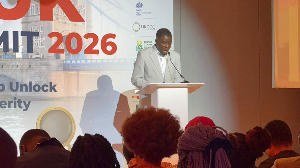
 Kotoko noted that climate change should not be viewed solely as an environmental issue
Deputy Chief Executive Officer of the Forestry Commission, Elikem Kotoko, has called for stronger investment in climate action, sustainable development, and environmental protection, stressing that Environmental, Social and Governance (ESG) principles have become critical to economic growth and resilience.
Speaking at the Ghana-UK Summit in London, Kotoko said ESG is no longer merely a framework for sustainability reporting but has become an important factor in investment decisions, business competitiveness, risk management, and long-term economic resilience.
"Today, ESG is no longer simply a sustainability reporting framework. It has become a key driver of investment decisions, business competitiveness, risk management, and long-term economic resilience," he said.
According to him, climate change should not be viewed solely as an environmental issue but also as a social and governance challenge.
"The social dimension reminds us that climate action must improve livelihoods, create jobs, empower women and youth, and ensure that local communities benefit from sustainable development," he stated.
Kotoko highlighted Ghana's forestry and climate initiatives, including the Ghana Cocoa Forest REDD+ Programme and the Ghana Shea Landscape Emission Reduction Project, noting that they are helping to restore degraded lands, reduce emissions, and improve livelihoods.
He further noted that Ghana is participating in international carbon markets, creating opportunities in agroforestry, ecosystem restoration, ecotourism, and biodiversity conservation.
"Investors are increasingly looking for opportunities that generate both financial returns and measurable environmental and social impacts. This presents a significant opportunity for Ghana," he said.
Kotoko stressed that attracting investment requires strong governance systems, transparency, and accountability.
Looking ahead, he identified key priorities, including increasing investment in nature-based solutions, ensuring local communities benefit from climate finance, strengthening governance systems, and encouraging greater private-sector participation.
"Public finance alone will not be sufficient to address the climate challenge," he said.
In conclusion, Kotoko urged stakeholders to view forests as more than conservation resources.
"For Ghana, forests are no longer only conservation assets. They are climate assets, development assets, and investment assets," he stressed.
AK/MA

Copyright © 1994 - 2026 GhanaWeb. All rights reserved.










