



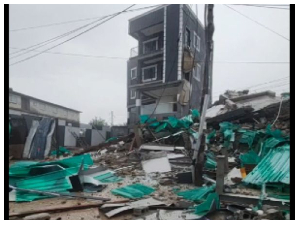
 Investigators noted that the building was effectively a trap, unable to safely distribute its weight
A joint team of engineering and architectural regulators has pinpointed severe structural defects, including substandard concrete and poorly executed load-bearing elements, as the primary drivers behind the catastrophic building collapse within the La Nkwantanang Madina Municipal Assembly (LaNMMA).
The Joint Technical Investigative Committee assembled from specialized structural engineers and statutory representatives from the Structural Subdivision of the Ghana Institution of Engineering (GhIE), the Institution of Engineering and Technology, Ghana (IET-Gh), and the Architecture Registration Council (ARC) released its preliminary findings on Monday, June 8, 2026.
The committee's initial on-site forensic assessment revealed a litany of fundamental engineering failures that crippled the building's structural integrity.
Investigators noted that the building was effectively a trap, unable to safely distribute its own weight down to its base.
Among the critical weaknesses identified were:
• Discontinuous load-bearing columns that interrupted the building's vertical support system.
• Inadequate structural support systems failing to reinforce key transit points.
• Poor-quality concrete mixtures lacking the required compressive strength.
• Improperly detailed reinforcement steel, which severely compromised structural resilience.
These combined deficiencies culminated in a progressive or ‘pancake’ collapse.
Multiple feared dead as storey building collapses at Adenta
In this specific failure pattern, the sudden snapping or buckling of a single critical structural element immediately overburdens surrounding areas, triggering a rapid, sequential flattening of multiple floors onto one another.
To establish definitive scientific proof and support potential regulatory or legal actions, investigators have extracted core samples of the concrete and pieces of the structural reinforcement steel from the debris.
“These materials have been sent to certified laboratories to measure their exact compliance against national engineering and construction standards,” the statement partly said.
Furthermore, because sections of the remaining building stand compromised, the committee has directed the National Disaster Management Organisation (NADMO) to enforce a strict security perimeter around the disaster zone.
The committee advised that the highly unstable portions of the surviving framework must be carefully dismantled under professional guidance to protect the public from secondary collapses and to clear a safe path for ongoing investigations.
The regulatory bodies stated that this tragedy must serve as a harsh wake-up call to developers, contractors, and municipal authorities across Ghana.
They stressed that the disaster was entirely preventable through basic compliance with established building regulations, consistent professional site supervision, and rigorous adherence to approved engineering and architectural blueprints.
In a joint statement, the GhIE, IET-Gh, and the ARC reaffirmed their total commitment to working alongside state security and municipal authorities to determine legal accountability, overhaul current structural enforcement mechanisms, and clean up construction practices across the country to protect human lives.
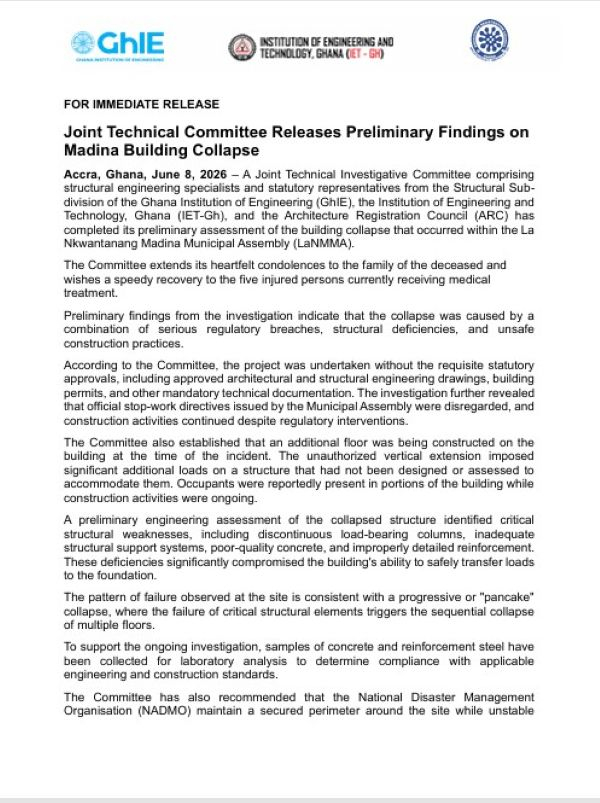
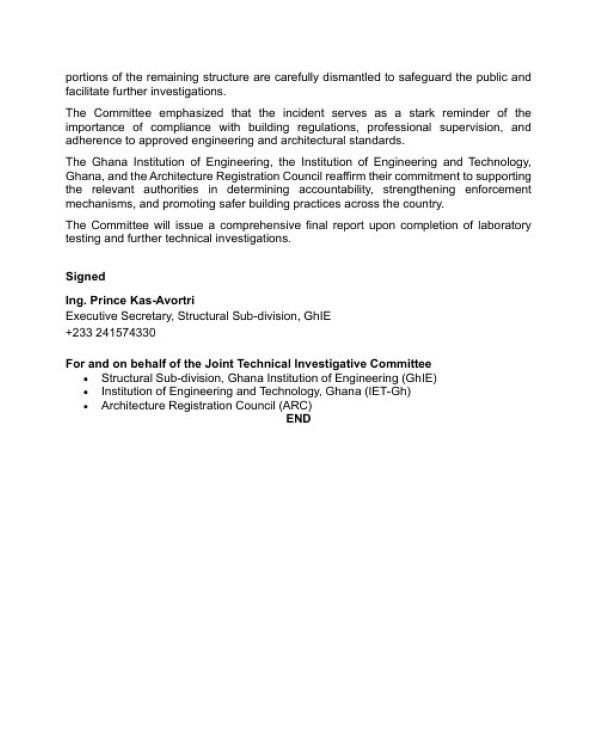
Read full statement below
MRA/VPO
BREAKING: Two rescued, one in critical condition after building collapse at Avenor

Copyright © 1994 - 2026 GhanaWeb. All rights reserved.










