



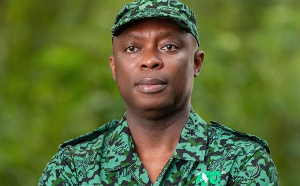
 Dr Hugh Brown, CEO of the Forestry Commission
Ghana earned about US$260 million from timber and timber product exports and domestic sales in 2025, contributing significantly to government revenue, the Chief Executive Officer of the Forestry Commission, Dr Hugh Brown, has disclosed.
According to him, a total volume of 952,000 cubic metres of timber and timber products was supplied to both local and international markets last year. In addition, ecotourism sites within wildlife parks and forest reserves attracted about 800,000 visitors, representing an increase of more than 20 per cent over the previous year.
Dr Brown made the remarks in Accra on Friday during the launch of the **2026 edition of the Tree for Life (T4L) Reforestation Initiative**, which coincided with this year's World Environment Day celebrations.
The event was held under the global theme, "Inspired by Nature, For Climate, For Our Future," and the Tree for Life theme, "Forests and Economies."
He said forests remain critical to Ghana's socio-economic development, noting that about 20 percent of the country's population** depends directly or indirectly on forest resources for livelihoods, food security, and healthcare needs.
Ghana's forest cover, he stated, is estimated at 6.4 million hectares, representing about 27 percent of the country's land area. Of this, 1.02 million hectares is classified as closed-canopy forest, while 5.37 million hectares is classified as open forest.
Dr Brown said forests also play a vital role in sustaining Ghana's cocoa industry by providing favourable microclimatic conditions. They also serve as important watersheds for major rivers, including the Pra, Birim, Ayensu, Ankobra, Densu, Tano, and Ofin.
He indicated that the forestry sector generates direct and indirect employment for about 800,000 people through activities such as logging, timber processing, furniture manufacturing, plantation development, ecotourism, herbal medicine practice, and forest management.
Despite these benefits, Dr Brown expressed concern over the persistent threat of deforestation and forest degradation, particularly within the high forest zone, warning that the trend continues to endanger biodiversity, wildlife habitats, and the livelihoods of forest-dependent communities.
Highlighting achievements under the 2025 Tree for Life Initiative, he said a total of 23,600 hectares** of degraded and deforested land was restored through enrichment planting and plantation development.
Additionally, 1.9 million seedlings were planted under the amenity planting programme, while 2.1 million seedlings were established on farms under the Trees-on-Farm component.
"In total, about 30.8 million tree seedlings were planted across the country by the Forestry Commission, private sector organisations, and civil society groups," he stated.
Dr Brown disclosed that a recent survival assessment showed encouraging results, with seedling survival rates ranging between 65 and 85 percent in the high forest zone and between 40 and 78 percent in the northern savannah ecological zone.
For the 2026 planting season, he said the Forestry Commission, in collaboration with private sector partners and other stakeholders, aims to plant **30 million seedlings** nationwide.
He therefore appealed to Ghanaians to support the initiative by obtaining free seedlings from Forestry Commission offices across the country and ensuring that planted trees are properly nurtured.
Dr Brown also outlined several interventions being undertaken by the Commission to strengthen forest governance, including the review of the Forestry Commission Act, the introduction of payment-for-ecosystem-services schemes, enhanced ecotourism investments, the establishment of forest protection camps, and intensified training for frontline staff.
He stressed that sustained forest conservation requires long-term planning, strong partnerships, and collective action, urging all stakeholders to work together to halt deforestation, restore degraded landscapes, and secure Ghana's forests for future generations.

Copyright © 1994 - 2026 GhanaWeb. All rights reserved.










