



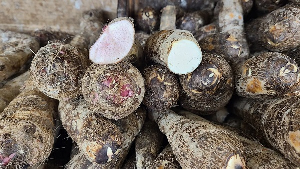
 Many traditional crops once common in Ghanaian households were becoming scarce
The Council for Scientific and Industrial Research (CSIR) has warned that several indigenous Ghanaian crop varieties are gradually disappearing from farms and dining tables, even as demand and prices for the crops continue to rise on international markets.
According to a report by graphic.com.gh on June 10, 2026, the Director of the Plant Genetic Resources Research Institute at Bunso, Dr Daniel Ashie Kotey, said many traditional crops once common in Ghanaian households were becoming scarce, raising concerns about the permanent loss of valuable plant genetic resources.
“The West is looking for these, our indigenous stuff, which are way healthier, and they are pricing them higher,” Dr Kotey said.
He described the situation as a “quiet emergency” in Ghana’s food and farming systems, explaining that indigenous crop varieties were steadily disappearing from both farms and dining tables.
“As the National Gene Bank, our responsibility is to make sure that this loss is not irreversible,” he said.
To safeguard the country’s agricultural heritage, the institute has been conserving thousands of crop varieties and maintaining duplicate collections at the Svalbard Global Seed Vault in Norway.
Ghana became the 100th institution worldwide to deposit seeds at the facility in October 2023, sending varieties of maize, rice, eggplant and cowpea.
“If we lose everything in Ghana, we can recall some of this material,” Dr Kotey noted.
He cited water yam, locally known as Afaseɛ, yellow yam (Mankani), and African rice (Oryza glaberrima) among indigenous crops that have declined in cultivation and consumption over the years.
He added that even among crops that remain widely grown, such as cowpea, traditional varieties are being abandoned in favour of larger-seeded and faster-cooking alternatives.
Cheap imports threaten local poultry industry – Stakeholders
Dr Kotey attributed the decline to changing consumer preferences, climate change, urbanisation and farming practices that reduce biodiversity.
“Our kids no longer eat some of the things that we used to eat,” he said, explaining that reduced consumption discourages farmers from cultivating the crops.
The Bunso-based institute currently conserves about 6,000 accessions of crop genetic resources, including more than 600 varieties each of maize, rice and cowpea, alongside hundreds of tomato and pepper varieties.
It also preserves indigenous leafy vegetables such as ayoyo, ademe and alefu, as well as crops including African yam bean, pigeon pea and bambara groundnut.
Dr Kotey said Ghana was also missing out on significant economic opportunities linked to indigenous crops. He pointed to baobab as an example, noting that countries outside Africa were developing commercial products from the plant while it remained largely underutilised in Ghana.
“Over here, we have left it in the wild,” he said.
Beyond conservation, the institute supplies planting materials to farmers, researchers, breeders and students, and reproduces rare varieties when demand exists.
“The value of what we do is justified by use. If we collect and conserve and nobody uses them, there’s no point,” Dr Kotey said.
He stressed that the institute’s mission is to ensure Ghana’s agricultural heritage remains available for future generations.
“We make sure that the chapters of our food heritage are not lost forever. We are the library that makes sure that future generations can have access to these things,” he said.
MRA/VPO
Meanwhile, watch as Jeffery Nortey shares his career journey from comedy to content creation

Copyright © 1994 - 2026 GhanaWeb. All rights reserved.










